
What Is USSD? Meaning, How It Works, and Business Uses
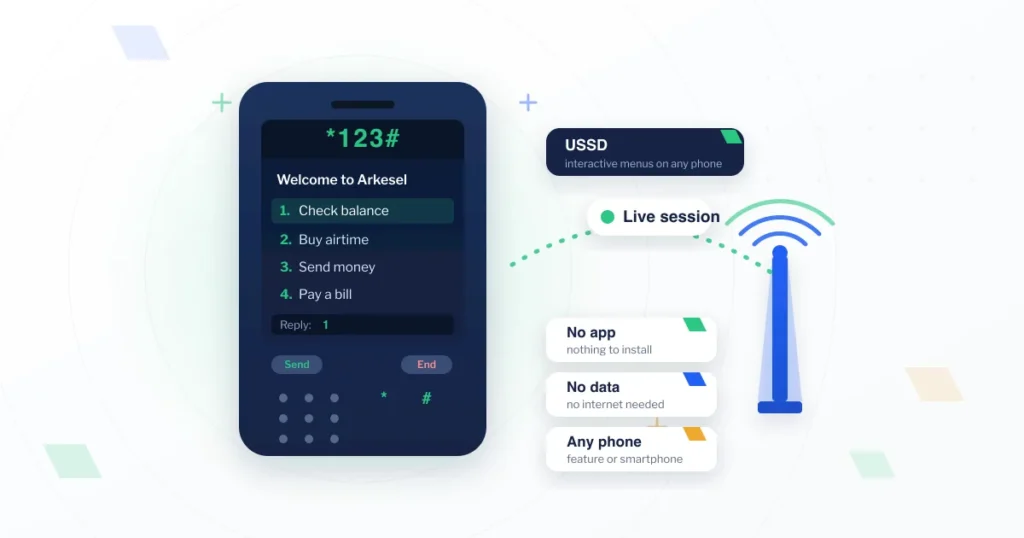
USSD (Unstructured Supplementary Service Data) is the technology behind the *123#-style codes you dial on a mobile phone to open a menu — check your balance, buy airtime, or send mobile money. You dial a short code, a live menu appears, you make a choice, and you get an answer in seconds. It works on any mobile phone, needs no app, and uses no mobile data.
In plain terms, that is the USSD meaning: a real-time, interactive menu that works on every phone. It is why USSD powers so much of how Africa banks, pays, and transacts.
What does USSD mean?
USSD stands for Unstructured Supplementary Service Data. It’s a session-based protocol built into the GSM mobile network — the same network that carries calls and SMS.
When you dial a code like *123#, your phone opens a live two-way session with an application running on the other end. You see a text menu, you reply with a number, and the application responds instantly — all within that one session. When you finish, the session closes.
You’ve almost certainly used it already. Every mobile-money menu, airtime top-up code, and bank balance check you’ve dialled in Ghana or anywhere in Africa runs on USSD.
How does USSD work?
USSD works in one continuous session, not as separate stored messages. Here’s the flow:
- You dial a short code, such as
*123#. - The network opens a live session between your phone and the application behind that code.
- A text menu appears on your screen. You reply by entering a number or short text.
- The application processes your choice in real time and sends back the next screen.
- You navigate the menu until you’re done, then the session ends.
The whole exchange happens over the GSM signalling channel — the same channel that connects your calls. That’s why USSD needs no internet connection, no app to install, and no mobile data. It runs the same way on a basic feature phone and the newest smartphone.
USSD vs SMS: what’s the difference?
USSD and SMS both send short text over the mobile network, but they behave very differently.
USSD is interactive and session-based. You dial a code, a menu opens, and you and the application exchange messages back and forth in real time until the task is done. Nothing is stored — the conversation lives only for the length of the session.
SMS is one-way and store-and-forward. A message is sent, stored by the network, and delivered to the recipient’s inbox. It’s perfect for notifications and alerts, but it doesn’t open a live menu the customer can navigate.
In short: reach for SMS when you need to tell a customer something. Reach for USSD when you need the customer to do something — choose an option, check a balance, complete a request — right there on the phone. For a fuller breakdown across channels, see our guide on USSD vs SMS vs WhatsApp.
What can a business do with USSD?
Because USSD reaches every phone with no app and no data, it lets you build interactive services your entire customer base can use. Here are five ways businesses put it to work.
1. Customer engagement
USSD turns one-way broadcasts into a two-way conversation. Customers dial your code, navigate a menu, and act — opt into a promotion, confirm a delivery, or update their details — without leaving the session. You reach customers in real time and let them respond on the spot.
2. Customer feedback and surveys
Run surveys customers actually complete. A short USSD menu lets you collect ratings, opinions, and quick answers in real time, straight from the phone — no app download, no data, no link to click. You get clean, structured responses from a far wider audience than online forms reach.
3. Lead generation
Promote a simple code on a flyer, radio spot, or product pack, and turn interest into captured leads. Customers dial in to enter a competition, claim an offer, or register, and you collect their details and qualify them by how they respond — all in one interactive session.
4. Customer support self-service
Give customers a self-service line they can reach on any phone. A USSD menu lets them check an order, track a balance, or resolve common questions instantly, easing pressure on your support team and giving customers answers the moment they need them.
5. Payment collection
Many mobile-money services are reached through a USSD menu, which makes USSD a natural fit for collecting payments. Prompt customers to pay an invoice, settle a bill, or complete a purchase through a menu they navigate on their own phone — no smartphone or extra app required.
See how Arkesel USSD lets customers self-serve with no app and no data — on every phone. Explore Arkesel USSD Solutions.
Real-world USSD in Ghana
The clearest way to understand USSD is to look at a service people already use every day.
MTN MoMo in Ghana runs on USSD. According to MTN Ghana, customers dial *170# and select Financial Services, then Loans, to reach one of its MoMo services. Each step is a numbered menu on the phone, with no app to open and no data needed.
The same kind of menu runs mobile money on Ghana’s other networks. USSD is how interactive services reach customers who don’t have a smartphone or steady data. To go deeper on this, read our guide on USSD for mobile money and financial services.
USSD for your business with Arkesel
USSD gives you one rare advantage: a single interactive channel that reaches every customer, on every phone, with no app and no data. That reach is why it remains a workhorse for engagement, self-service, and payments across Africa.
Arkesel USSD Solutions lets you build exactly these services in Ghana — interactive menus, real-time sessions, and custom shortcodes your customers can dial on any device. You design the menu; we connect it across MTN, Telecel, and AirtelTigo.
Want the bigger picture first? See how businesses put the channel to work in our guide to USSD for business in Africa. Ready to act? Here’s how to get a USSD shortcode in Ghana.
Frequently asked questions about USSD
Is USSD free? For the customer, dialling a USSD code uses no mobile data. Whether a session itself carries a network charge depends on the service and operator. Businesses pay to run a USSD service; customers never need data to use one.
What is a USSD code? A USSD code, or shortcode, is the short string you dial to open a USSD session — usually starting with * and ending with #, like *123#. It’s the address that connects your phone to the application behind it.
Does USSD need internet? No. USSD runs over the GSM signalling network, the same channel as calls and SMS. It works with no internet, no mobile data, and no app — on any mobile phone.
What is USSD used for? USSD powers interactive services such as mobile money, airtime purchases, balance checks, surveys, customer self-service, and registration — anywhere a business needs customers to act through a menu on any phone.
Related Articles
- USSD Menu Design: What a USSD Menu Is and 10 Best Practices
- USSD Security: How to Protect Mobile Transactions from Fraud
- USSD vs Mobile App in Africa: When Each One Wins (2026)
- USSD Application Testing: Load Tests and the Tools to Use
Build interactive USSD services on any phone
USSD reaches customers no app or smartphone can — instantly, interactively, on the device they already carry. If your customers are in Ghana, it’s one of the most direct ways to engage, support, and collect from them.
Explore Arkesel USSD Solutions and build services your customers can reach on any phone.

USSD Application Testing: Load Tests and the Tools to Use
USSD application testing for Ghana: check every menu path on MTN, Telecel and AirtelTigo, then load…

WhatsApp Ticketing System: Turn Chats Into Tickets With SLAs That Fit the 24-Hour Window
A WhatsApp ticketing system turns chats into tickets with owners, statuses and SLA clocks. See how…

Email List Segmentation: How to Segment Your List for Higher Conversions
Email list segmentation for African marketers: the segments to build first, a decision table, list hygiene,…


