
SMS Marketing: Planning and Executing Effective Campaigns
SMS Campaign Planning: How to Plan and Execute Effective SMS Marketing Campaigns
SMS campaign planning is the process of deciding what you want a text message campaign to achieve, who receives it, what it says, when it sends, and how you measure success — before you send a single message. Plan it in seven stages: set a goal, segment your audience, write the message, fix the timing and consent, test, launch, and measure. Good SMS planning is the difference between a blast that gets ignored and a campaign that converts.
Text messages land where customers already look. SMS earns far higher open and response rates than email, and in Ghana mobile reach is near-universal — almost every customer carries a phone that receives a text within seconds. That reach is wasted on ad-hoc sends. This guide gives you an extractable planning checklist, the Ghana timing and consent rules you have to follow, real in-market examples, and a measurement loop you can reuse on every campaign.
Your SMS campaign planning checklist
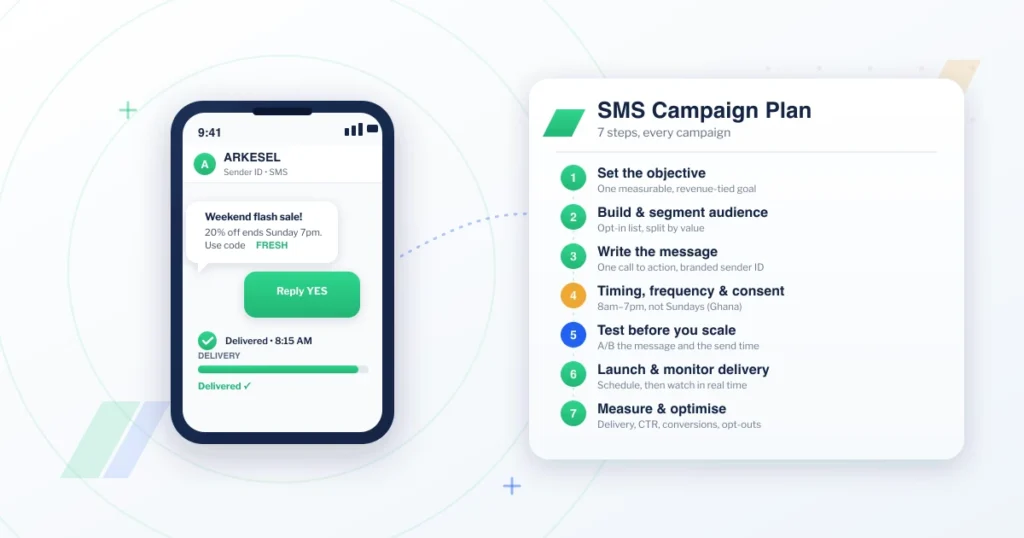
This is the whole of SMS campaign planning on one screen — the plan for any campaign. Each step is a section below.
- Set the objective — one clear, measurable goal tied to revenue or engagement.
- Build and segment the audience — an opt-in list, split by behaviour and value.
- Write the message — concise, one call to action, a recognisable sender ID.
- Fix timing, frequency and consent — send inside legal hours, cap frequency, honour opt-out.
- Test before you scale — A/B the message and timing on a small segment.
- Launch and monitor delivery — schedule the send and watch delivery in real time.
- Measure and optimise — read the numbers, then feed them into the next campaign.
Work the list top to bottom. Skip a step and you pay for it later — an unsegmented blast, a message that breaks the law, or a launch you cannot measure.
How do you set a clear, measurable SMS campaign goal?
Start with one objective you can count. “Drive more sales” is a wish. “Recover 100 abandoned carts this weekend” is a goal.
Tie every campaign to a number: revenue from a flash sale, bookings from a reminder, sign-ups from a launch. A SMART objective — specific, measurable, achievable, relevant, time-bound — tells you exactly what success looks like before you spend on sending.
The goal also shapes everything downstream. A revenue goal needs a strong offer and a deadline. A retention goal needs a helpful, well-timed nudge. Decide the number first; the rest of the plan serves it.
How do you build and segment your SMS audience?
Start with consent, not contacts. Build your list from customers who opted in — at checkout, on a sign-up form, through a keyword campaign, or via a USSD or web opt-in. A clean, consented list protects deliverability and keeps you on the right side of the rules.
Then segment. One message to your whole database underperforms a targeted message to the right slice. Split your list by behaviour and value:
- Recent buyers — upsell or ask for a review.
- Lapsed customers — win them back with a reason to return.
- High-value customers — early access and loyalty perks.
- Location — promote the branch nearest to them.
Segmentation lifts every metric that follows: more relevant messages get more clicks, fewer opt-outs, and better return on each send.
How do you write an SMS that converts?
You have one screen and a few seconds. Make every word earn its place.
- Lead with the value. Put the offer or the reason to act in the first line, before it gets truncated in a preview.
- One call to action. Tell the reader exactly what to do next — “Reply YES,” “Shop now,” “Use code FRESH.” One clear action, one link.
- Use a recognisable sender ID. A branded sender name (your business name instead of a random number) builds instant trust and lifts response. Register it before you send.
- Keep it tight. Short messages read faster and cost less to send. Cut filler words; keep the offer and the action.
Write two or three versions. You will test them in the testing step before committing your full budget.
When can you legally send promotional SMS in Ghana?
Timing is both a performance lever and a legal requirement — and in Ghana the regulator sets the rules.
According to the National Communications Authority’s consumer guidance, promotional electronic messages in Ghana should be sent only between 8:00 a.m. and 7:00 p.m., and not on Sundays. Schedule your sends inside that window. A message that arrives at the wrong hour annoys the customer and breaks the rules.
Consent and frequency matter just as much:
- Send only to opted-in contacts. No consent, no send.
- Honour opt-out. Every promotional message must give the customer an easy way to stop. Remove them immediately when they do.
- Respect frequency. Too many messages train customers to ignore — or unsubscribe from — your brand. Space your sends and keep each one worth opening.
For the full set of Ghana messaging rules — sender-ID conventions, frequency caps, and how to keep a campaign compliant end to end — follow our NCA-compliant bulk SMS workflow and the complete guide to SMS marketing in Ghana.
How do you test an SMS campaign before scaling?
Never send your first version to your whole list. Test on a small slice first.
Split a sample segment and A/B test the two variables that move results most: the message (offer, wording, call to action) and the timing (which legal hour earns the most clicks). Send version A to one group, version B to another, and compare.
A short test tells you which message and which send time perform — so you launch the winner to your full audience with evidence, not a guess. Testing on a small group costs little and protects your whole budget from a weak message.
How do you launch an SMS campaign and monitor delivery?
With the winning message chosen and the timing set, schedule the send for the optimal in-window slot. Scheduling lets you plan campaigns days ahead and fire them at the exact moment your audience is most likely to act.
At launch, watch delivery in real time. A campaign is only working if messages actually arrive. Real-time SMS delivery reports show you what landed and what failed, so you can spot a routing problem or a bad number list before it drains your send.
For recurring sends — welcome messages, payment reminders, post-purchase follow-ups — move beyond one-off launches and set up triggered SMS campaigns that convert automatically, so the right message fires the moment a customer acts.
How do you measure an SMS campaign’s success?
Every campaign ends where the next one begins: the numbers. Read four metrics after every send.
- Delivery rate — the share of messages that reached a real handset. Low delivery points to list hygiene or routing issues.
- Click-through rate — how many recipients tapped your link. This tells you whether the message and offer landed.
- Conversions — the goal you set in step one: sales, bookings, sign-ups. The only number that proves the campaign paid off.
- Opt-out rate — how many customers unsubscribed. A spike is a warning that your frequency or relevance is off.
Write down what worked and what did not, then feed it into your next plan. That loop — measure, learn, adjust — is what turns one good campaign into a reliable channel.
SMS campaign examples that work in Ghana
The framework gets concrete when you see it run. Here are patterns Ghanaian and African businesses use every week.
The weekend flash sale (retail SME). A boutique segments its recent buyers, writes a 24-hour offer with a discount code and one link, schedules the send for Friday afternoon inside the legal window, and tracks redemptions by code. Goal: revenue in a fixed window. Measured: sales per message sent.
The appointment or payment reminder (services and finance). A clinic or a microfinance lender sends a timed reminder a day before a visit or a due date. Goal: reduce no-shows and late payments. The mobile-money prompts and balance alerts customers already receive from telcos prove the pattern — a well-timed transactional text changes behaviour. Measured: show-up rate and on-time payments.
The win-back (any business with a customer list). A business segments customers who have not bought in 90 days and sends a single reason to return — a new arrival or a returning-customer offer. Goal: reactivate dormant revenue. Measured: orders from the lapsed segment.
For a fuller set of revenue plays, see the ways Ghana SMEs use bulk SMS to boost sales. Each example follows the same seven steps — only the goal and the segment change.
Ready to put the plan into action? See how Arkesel’s SMS Platform schedules campaigns, manages sender IDs, and tracks delivery in real time.
Execute your plan with Arkesel’s SMS Platform
SMS campaign planning is only as good as the tool that sends it. Arkesel’s SMS Platform turns each planning step into an action:
- Sender IDs — register and manage a branded sender name so customers recognise you instantly.
- Segmentation and scheduling — target the right list and schedule sends for the exact in-window moment.
- Real-time delivery tracking — see what landed and what failed, message by message, the moment you launch.
- Direct carrier connections — messages routed straight to MTN, Telecel, and AirtelTigo for high deliverability.
- Scale — send to a few hundred customers or a few million with the same reliable delivery.
That is the engine behind every step of this guide — from a single flash sale to an automated reminder programme.
Frequently asked questions
How do you plan an SMS marketing campaign? To plan an SMS marketing campaign, work seven stages in order: set one measurable goal, build and segment an opt-in audience, write a concise message with one call to action, fix the timing and consent, test on a small segment, launch and monitor delivery, then measure and optimise. Reuse the same checklist on every campaign.
What are the steps to plan and execute an SMS campaign? Objective, audience and segmentation, message, timing and frequency, consent, send, and measure. Each step feeds the next — your goal shapes the message, your segments shape the targeting, and your results shape the next plan.
When can you legally send promotional SMS in Ghana? According to the National Communications Authority, promotional messages in Ghana should be sent only between 8:00 a.m. and 7:00 p.m., and not on Sundays. You must also send only to opted-in contacts and give every recipient an easy way to opt out.
How often should you send marketing text messages? Send only as often as you have something worth opening, and space your campaigns so customers do not feel spammed. Over-sending raises opt-out rates and trains customers to ignore you; relevance and restraint protect the channel. Match your frequency to Ghana’s messaging rules.
How do you measure an SMS campaign’s success? Track delivery rate, click-through rate, conversions against the goal you set, and opt-out rate. Conversions prove the campaign paid off; the other three tell you why — and what to fix on the next send.
Plan your next campaign
Great SMS campaigns are planned, not improvised — a clear goal, the right segment, a tight message, legal timing, and a measurement loop that makes the next one sharper. Anchor that plan to the market you serve and you outperform every generic blast.
Plan your next SMS campaign on Arkesel’s SMS Platform — sign up and start sending.

How to Send Automated Birthday SMS to Your Customers
How to send birthday SMS to customers automatically: the group setup, the 08:00 daily run, the…

How to Become a Bulk SMS Reseller in Ghana: The Business Model and What to Ask a Supplier
How to become a bulk SMS reseller in Ghana: how wholesale capacity works, 8 questions to…

Bulk SMS in Tanzania: What Businesses Need to Know Before Choosing a Provider (2026)
Choosing a bulk SMS provider in Tanzania? Compare network reach, deliverability, sender ID compliance, and API…


