
Your customers in Lagos use WhatsApp. Your customers in rural Ghana rely on SMS. Your enterprise clients in Nairobi expect a phone call.
One channel will never be enough. Africa’s communication landscape demands a multi-channel strategy — and the businesses that get the mix right win customer loyalty.
This guide compares WhatsApp vs SMS vs Voice across Africa, gives you a head-to-head comparison, and delivers a practical decision framework to build the right channel mix for your African customers.
The Three Channels: WhatsApp, SMS, and Voice in Africa Today
Africa’s mobile ecosystem is unlike any other market.
Half of Sub-Saharan Africa’s population now subscribes to mobile services. Mobile technologies generate 7.7% of Africa’s GDP — $220 billion in economic value. That is not a trend. That is infrastructure.
But here is what makes Africa unique: your customers span the full spectrum of mobile technology. Smartphone users on WhatsApp. Feature phone users who depend on SMS. Customers who prefer voice because it is faster, more personal, or the only channel that works in their language.
The right channel strategy accounts for all three.
If you are already thinking about how WhatsApp CRM for African businesses fits into this picture, you are on the right track. But WhatsApp alone leaves significant customer segments unreachable.
WhatsApp in Africa: The Dominant Messaging Channel
WhatsApp has 320 million users across Africa. In Nigeria, 95% of internet users are on WhatsApp. South Africa sits at 93.9%. Ghana at 91.8%.
This is not just adoption. It is culture. Africa is WhatsApp-first.
Why WhatsApp dominates for engagement:
- Open rates reach 98-99%
- Click-through rates hit 35-45% — compared to 1-6% for SMS
- Rich media support: images, videos, documents, location sharing
- Two-way conversational messaging
- WhatsApp Business surpassed 400 million monthly active users globally in Q1 2025
The cost model: WhatsApp uses conversation-based pricing — typically $0.005 to $0.05 per 24-hour conversation window, though rates vary by market and message category. You pay per conversation, not per message. For businesses sending multiple messages within a support interaction, this model delivers real value.
WhatsApp excels at conversational support, marketing campaigns with rich media, and customer engagement that requires back-and-forth dialogue. You can even set up a WhatsApp AI chatbot in Africa to automate responses at scale.
Connect to WhatsApp at scale through the Arkesel WhatsApp Business API.
The limitation: WhatsApp requires a smartphone and internet connection. In markets where feature phones still dominate rural areas, WhatsApp cannot be your only channel.
SMS in Africa: Universal Reach That No Channel Can Match
SMS works on every mobile phone ever made. No smartphone required. No internet required. No app to download.
That is universal reach — and in Africa, universal reach matters.
Why SMS remains essential:
- Works on feature phones and smartphones alike
- No data connection needed
- 98% open rates
- Direct carrier delivery through network connections like MTN, Vodafone, and AirtelTigo
- Near-instant delivery for time-sensitive messages
SMS is the reliability backbone of your communication strategy. Transactional alerts, OTP codes, payment confirmations, appointment reminders — these messages cannot afford to depend on an internet connection.
For a deeper look at how SMS stacks up against voice specifically, explore our breakdown of SMS vs voice for business. This guide expands that comparison by adding the WhatsApp dimension and African market context.
Deliver SMS at scale with the Arkesel SMS Platform — direct mobile network connections and 99.9% delivery rates.
The limitation: SMS caps at 160 characters per segment. No rich media. No two-way conversation flow. For complex interactions, SMS falls short.
Voice in Africa: When Conversations Need a Human Touch
Some interactions demand a voice.
Complex issue resolution. High-value sales conversations. Customers who are more comfortable speaking than typing. Multilingual support in local languages where text feels impersonal.
Voice is the trust channel.
Why voice still wins for certain interactions:
- IVR in any language — critical for Africa’s multilingual markets
- Works with or without internet
- 99.9% call clarity
- Accessibility for non-literate customers
- Emotional nuance that text channels cannot replicate
- Complex issue resolution in a single interaction
Arkesel VoiceConnect delivers crystal-clear IVR and voice communications with enterprise-grade reliability.
The limitation: Voice is the most expensive channel per interaction. It does not scale the way messaging does. And younger demographics increasingly prefer text-based communication.
Channel Comparison: WhatsApp vs SMS vs Voice for African Businesses
Here is how the three channels compare across the metrics that matter most for African businesses:
| Factor | SMS | Voice | |
|---|---|---|---|
| Reach | Smartphone users with internet (320M in Africa) | Every mobile phone — universal | Every mobile phone — universal |
| Internet required | Yes | No | No (traditional) |
| Open/answer rate | 98-99% | 98% | Varies widely by use case |
| Click-through rate | 35-45% | 1-6% | N/A |
| Rich media | Images, video, documents, location | Text only (160 chars) | Voice only |
| Two-way conversation | Native | Limited | Native |
| Cost model | Per conversation window (varies by market) | Per message | Per minute |
| Best for | Conversational support, marketing | Transactional alerts, OTPs | Complex issues, multilingual support |
| Feature phone support | No | Yes | Yes |
| Multilingual capability | Text-based | Text-based | IVR in any language |
This is not about picking a winner. Each channel dominates different use cases. The question is: which combination serves your customers best?
Ready to connect all three channels? See how Arkesel connects WhatsApp, SMS, and Voice in one platform — reach every customer on their preferred channel.
How to Choose: A Decision Matrix for African Businesses
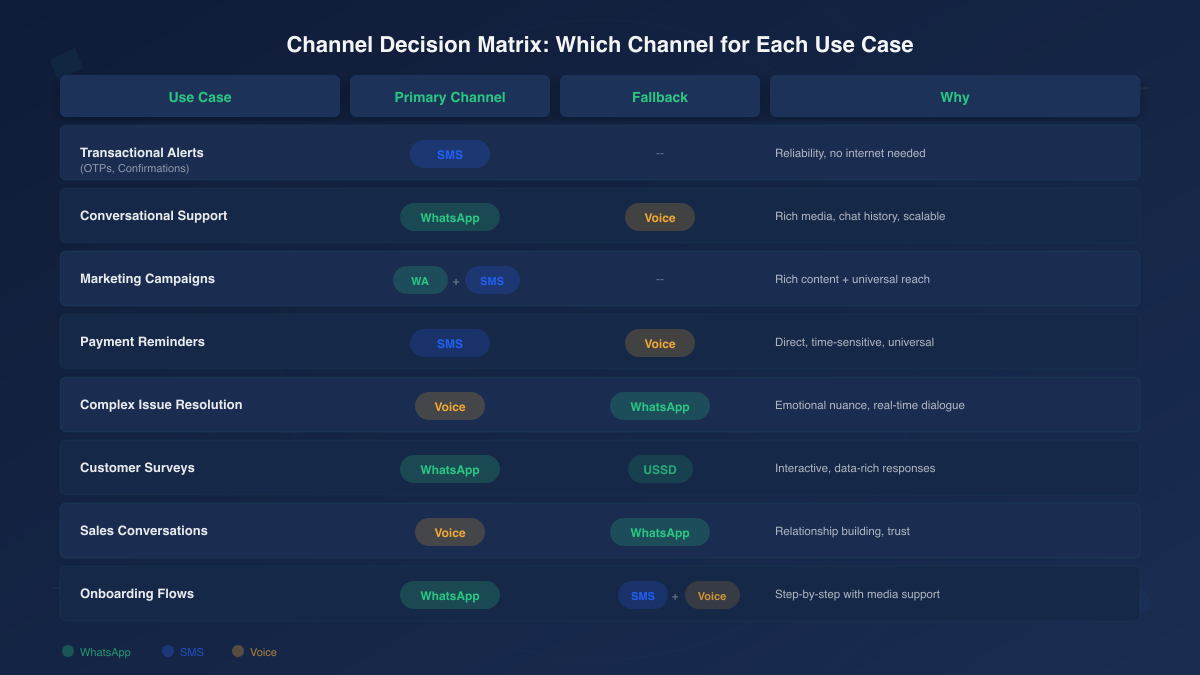
Map your customer interactions to the right channel:
| Use Case | Primary Channel | Fallback Channel | Why |
|---|---|---|---|
| Transactional alerts (OTPs, confirmations) | SMS | — | Reliability, no internet needed |
| Conversational support | Voice | Rich media, chat history, scalable | |
| Marketing campaigns | WhatsApp + SMS | — | WhatsApp for rich content, SMS for universal reach |
| Payment reminders | SMS | Voice | Direct, time-sensitive, universal |
| Complex issue resolution | Voice | Emotional nuance, real-time dialogue | |
| Customer surveys | USSD for business in Africa | Interactive, data-rich responses | |
| Appointment reminders | SMS | Concise, reliable delivery | |
| Sales conversations | Voice | Relationship building, trust | |
| Onboarding flows | SMS + Voice | Step-by-step with media support |
Notice the pattern: no single channel covers every scenario. The strongest strategies assign a primary channel and a fallback for each interaction type.
For feature phone-heavy markets, consider adding Arkesel USSD Solutions as a complementary fourth channel — interactive engagement with zero data cost.
Building Your Channel Mix Strategy
Follow this four-step framework to build a channel mix that fits your market:
Step 1: Map Your Customer Segments
Start with your customers, not your channels.
- Smartphone penetration: What percentage of your customer base uses smartphones vs. feature phones?
- Urban vs. rural split: Urban customers skew WhatsApp-first. Rural customers may depend on SMS and voice.
- Age demographics: Younger audiences prefer messaging. Older audiences often prefer voice.
- Language diversity: Do your customers need support in languages where text is not the natural medium?
Step 2: Categorize Your Interactions
Group every customer interaction into categories:
- Transactional: OTPs, order updates, payment confirmations
- Marketing: Promotions, product launches, re-engagement
- Support: Troubleshooting, complaints, inquiries
- Sales: Lead nurturing, consultations, closing
- Feedback: Surveys, NPS, reviews
Step 3: Assign Primary and Fallback Channels
Use the decision matrix above. Every interaction type gets a primary channel and, where possible, a fallback.
The fallback matters. If a WhatsApp message goes unread after 24 hours, trigger an SMS. If an SMS requires a complex response, escalate to voice.
Step 4: Measure and Optimize
Track delivery rates, open rates, response times, and resolution rates per channel. Look for patterns:
- Which channel drives the highest engagement for each interaction type?
- Where are customers dropping off?
- Which fallback paths get activated most often?
This is where real-world omnichannel customer experience examples become valuable — learn from businesses already running multi-channel strategies.
For a broader framework on designing these experiences, explore our customer experience strategy guide or the step-by-step approach to build a customer experience strategy.
How AI Customer Intelligence Connects Your Channels
Running three channels creates three data streams. Without a unified view, you are flying blind.
This is where AI-powered customer intelligence transforms your channel strategy.
Kova IQ unifies data from WhatsApp, SMS, and voice into a single customer view. Every interaction — regardless of channel — feeds into one intelligence layer.
What unified channel intelligence delivers:
- Sentiment analysis across channels: Understand how customers feel during WhatsApp conversations, SMS exchanges, and voice calls. Track sentiment shifts over time. Learn more about customer sentiment analysis for African enterprises.
- Channel preference mapping: Identify which customers prefer which channels — then route communications accordingly.
- Conversation analytics: Spot patterns in support tickets, marketing responses, and sales conversations across all three channels.
- Real-time optimization: Shift budget and effort toward the channels delivering the strongest engagement for each customer segment.
Without this intelligence layer, you are guessing which channel works best. With it, you know.
For businesses evaluating platforms that bring this together, our comparison of the best omnichannel communication platforms covers the landscape.
Frequently Asked Questions
What is the best communication channel for businesses in Africa?
There is no single best channel. The strongest approach combines WhatsApp (for smartphone users and conversational engagement), SMS (for universal reach and transactional reliability), and voice (for complex interactions and multilingual support). Your ideal mix depends on your customer demographics and interaction types.
Is WhatsApp better than SMS for business communication in Africa?
WhatsApp delivers higher engagement — click-through rates of 35-45% compared to 1-6% for SMS. But SMS reaches every phone, with or without internet. For transactional alerts and feature phone markets, SMS is the more reliable choice. Most African businesses need both.
How do African businesses use WhatsApp for customer communication?
African businesses use WhatsApp for customer support, order updates, marketing campaigns with rich media, appointment scheduling, and AI-powered chatbot interactions. With 320 million users across Africa, WhatsApp is the primary conversational channel for businesses targeting smartphone users.
When should I use voice calls instead of messaging?
Use voice for complex issue resolution, high-value sales conversations, multilingual support in local languages, and interactions with non-literate customers. Voice builds trust in ways text cannot. It is the right choice when emotional nuance and real-time dialogue matter more than scale.
Start With Your Customer, Not Your Channel
The channel mix question is not about technology. It is about your customers.
Map their preferences. Understand their devices. Categorize your interactions. Then assign the right channel to the right moment.
WhatsApp for engagement. SMS for reliability. Voice for trust.
And when you connect all three with AI-powered intelligence, you stop guessing and start knowing what works.
Reach every customer on their preferred channel. Explore Arkesel’s multi-channel platform — WhatsApp, SMS, and Voice, unified with Kova IQ intelligence.
Related Articles
- AI Chatbot for WhatsApp Business in Africa: Setup Guide — Build and deploy an AI-powered chatbot for WhatsApp customer interactions across African markets.
- Customer Sentiment Analysis: A Practical Guide for African Enterprises — Implement sentiment analysis across WhatsApp, SMS, voice, and USSD to understand how your customers feel in real time.
- How to Build a Customer Database from WhatsApp Conversations — Extract, structure, and activate customer data from WhatsApp conversations using manual, API, and AI-powered methods.
- WhatsApp AI Features for Business in South Africa: What You Can Do in 2026


