
Best WhatsApp AI Chatbot for African Business: How to Choose & Set One Up (2026)
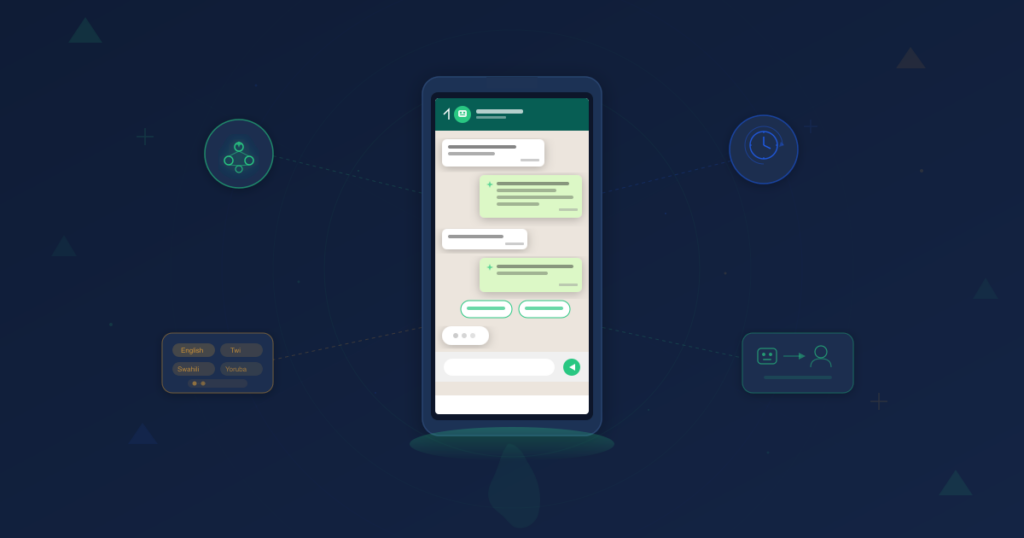
WhatsApp is the leading messaging app across Ghana, Nigeria, Kenya, and South Africa. Your customers are already there. The question is whether your business can keep up.
Most businesses still rely on manual responses. A team member checks WhatsApp between tasks, replies when they can, and hopes nothing falls through the cracks. That approach breaks the moment you scale past a handful of daily conversations.
The best WhatsApp AI chatbot changes the equation. It responds instantly, handles routine queries around the clock, and frees your team for the conversations that need a human. This guide shows you how to choose the right platform for an African business — and how to set one up end to end.
For the strategic view, start with our WhatsApp Business API in Africa guide — the pillar that frames how messaging is reshaping customer engagement across the continent.
What Is an AI Chatbot for WhatsApp Business?
An AI chatbot for WhatsApp Business is an automated assistant that connects to the WhatsApp Business API, understands natural-language questions, and replies in real time using your business knowledge. Unlike a rule-based menu bot, it reads open-ended messages, draws answers from your FAQs and product catalog, and escalates the hard cases to a human. The best ones sit inside a customer engagement platform, so every conversation is tracked, not lost.
What Is a WhatsApp AI Chatbot (and How Is It Different from a Basic Bot)?
Before you choose a platform, get clear on the tools you’re working with.
WhatsApp Business App is the free app for small businesses. It supports quick replies, labels, and a product catalog. But it’s limited to one device, manual responses, and no automation beyond canned messages.
WhatsApp Business API (the WhatsApp Business Platform) is the enterprise-grade version. It connects to external systems, supports automation, handles unlimited conversations, and integrates with AI chatbots. You access it through a Business Solution Provider (BSP) — more on that below.
A rule-based chatbot follows pre-programmed scripts. It presents menus, waits for button clicks, and routes conversations down fixed paths. Ask it something off-script and it stalls.
An AI-powered chatbot uses natural language processing to understand open-ended questions. It’s trained on your business knowledge — FAQs, product catalogs, policies — and generates contextual responses. It learns from interactions and improves over time.
The difference matters. A rule-based bot can handle “Press 1 for pricing.” An AI chatbot can handle “I ordered two bags of rice last week and one arrived damaged — what do I do?”
A well-trained AI chatbot resolves most routine queries without human intervention. That’s not a novelty. That’s a support-team multiplier.
Why WhatsApp Chatbots Matter for African Businesses
WhatsApp is where the conversation already happens. Across Ghana, Nigeria, Kenya, and South Africa, it’s the default channel for talking to a business — mobile-first, familiar, and always open.
The scale is global, and it tells the story. More than 175 million people message a WhatsApp Business account every day, according to WhatsApp. That’s the audience your chatbot plugs into.
Attention follows. WhatsApp reports a 98% open rate for its messages, compared with about 20% for email, according to WhatsApp. When your reply lands in WhatsApp, it gets read — which is exactly why a fast, accurate AI response beats a missed email every time.
For African customers, the channel fit is decisive. WhatsApp works on the devices people already carry, in the languages they actually use, with payment flows that match how money moves locally. A chatbot meets them there.
How to Choose the Best WhatsApp AI Chatbot
Most “best chatbot” lists rank tools on price. For an African business, that’s the wrong starting point. Rank on fit and reliability first. Here’s the selection framework.
- Enterprise reliability and uptime. A chatbot that drops messages erodes trust faster than no chatbot at all. Look for a platform built on direct, dependable network connections and a clear uptime commitment.
- Africa accessibility. It must handle the languages your customers use — English, French, Swahili, Twi, Yoruba — and the code-switching common on WhatsApp across the continent. Local payment support matters too.
- No-code setup. Your marketing or CX team should build and update flows without filing engineering tickets. Drag-and-drop builders and template libraries keep you fast.
- CRM and inbox integration. Every conversation generates customer data. The platform should feed a unified inbox and a customer record — not a silo. This is where a messaging-first CRM like KOVA IQ pulls ahead of a standalone widget.
- WhatsApp policy compliance. The platform should support opt-in management, template approval, and quality-rating monitoring out of the box, so you stay in good standing with WhatsApp.
- AI answer quality. Test it with real, messy queries — misspellings, slang, mixed languages. Decision-trees wearing an “AI” label fall apart fast.
If you’re weighing the broader channel question, our guide on choosing the right WhatsApp, SMS, and voice channel mix puts chatbot selection in context.
Run your WhatsApp chatbot inside one unified inbox with AI-assisted replies — see how KOVA IQ works.
Step 1: Choose Your WhatsApp Business API Access Route
You can’t run an AI chatbot on the free WhatsApp Business App. You need the WhatsApp Business API. There are two paths to get it.
Direct Integration with Meta
You apply directly through Meta’s Cloud API. It’s free to set up, but you need developer resources to build and maintain the integration. You handle hosting, compliance, webhook management, and ongoing updates yourself.
This route works for companies with dedicated engineering teams. For most African businesses, it adds unnecessary complexity.
Through a Business Solution Provider (BSP)
A BSP handles the technical infrastructure for you. They manage API hosting, give you a dashboard, and often bundle chatbot-building tools into the platform.
This is the route most African businesses should take. Here’s what to evaluate when choosing a BSP for African markets:
- Local presence and support. Can you reach support during your business hours? Do they understand your market?
- Pricing transparency. Onboarding fees and per-message markups vary dramatically between providers, and the headline number rarely tells the whole story. Look for clear, published pricing with no hidden markups — compare total cost of ownership, and check current pricing before you commit.
- African carrier integrations. Direct connections with MTN, Telecel, AirtelTigo, and other local networks improve delivery reliability.
- Built-in AI and automation tools. Some BSPs offer API access only. Others — like Arkesel’s WhatsApp Business API — bundle chatbot capabilities, making it one fewer tool to integrate.
Don’t sign a long-term contract before testing the platform. Request a trial or pilot period.
Step 2: Select Your AI Chatbot Platform
With API access sorted, you need a platform to build and run the AI chatbot itself. Some BSPs include this. Others don’t — meaning you’ll need a separate chatbot tool that connects to your WhatsApp API.
Use the selection framework above, then weigh the platform type:
Standalone chatbot builders connect to your WhatsApp API and handle conversation automation. Good for simple FAQ bots. Limited when you need cross-channel visibility.
Integrated CX platforms combine chatbot, shared inbox, CRM, and analytics in one system. These are ideal when WhatsApp is one part of a broader customer experience strategy. You get one dashboard instead of four disconnected tools.
Custom-built solutions give maximum flexibility but require engineering resources to build and maintain. Best for enterprises with unique workflow requirements.
For most African businesses, an integrated platform offers the best balance of power and speed to market. You avoid stitching together multiple vendors — and the best customer communication tools already bundle everything you need.
Step 3: Design Your Chatbot Conversation Flows
Don’t start building in the platform. Start with a document.
Pull your top 10 customer questions from support tickets, call logs, and existing WhatsApp conversations. These are the flows your chatbot needs to handle on day one.
Core Flows to Map
Greeting and language selection. Offer language options upfront. In multilingual markets, this single step determines whether customers engage or abandon.
FAQ handling. Product information, business hours, location, return policies. These queries eat your team’s time but don’t need human judgment.
Lead qualification. Ask two or three questions to identify what the customer needs, then route them to the right next step — a product page, a sales rep, or an automated response.
Order status and tracking. Connect to your order management system so the chatbot pulls real-time status without a human lookup.
Appointment or callback booking. Let customers self-schedule instead of waiting for a reply.
Escalation to a human agent. Every flow should include a clear path to a real person. More on this in Step 5.
African Market Design Considerations
Keep menus concise. Many users are on slower connections or older devices. Long lists and nested menus create friction. Three to five options per level is the sweet spot.
Design for both text and buttons. WhatsApp supports interactive buttons and list messages, but some users prefer typing. Your chatbot should handle both input styles.
Account for data-cost sensitivity. Keep media files optional rather than required. Not every customer is on unlimited data.
Use conversational language. Match the tone your customers use on WhatsApp — direct, practical, human. Don’t write responses that read like a legal document.
When manual responses let customers down, the business impact is real. Slow replies and dropped conversations are textbook bad customer service examples — and exactly what a well-designed chatbot eliminates.
Step 4: Train Your AI on Your Business Knowledge
This is where AI chatbots separate from basic bots. You’re teaching the AI to understand your business — not just follow a script.
Building Your Knowledge Base
Upload everything the chatbot might need:
- FAQs and support documentation. The answers your team gives repeatedly.
- Product catalogs and pricing. Detailed enough that the chatbot can compare products and recommend options.
- Company policies. Returns, shipping timelines, warranty terms, payment methods.
- Objection handling. Common pushback and the responses that convert.
Training Best Practices
Start narrow. Don’t automate everything at once. Pick one use case — customer-support FAQ, for example — train the AI on it, test thoroughly, then expand.
Test with real queries. Don’t just test the happy path. Throw curveballs: misspellings, incomplete questions, slang, code-switching. Your customers will.
Build in personality. The chatbot represents your brand. It should sound like your company — professional but not robotic, helpful but not verbose.
Africa-Specific Training Tips
Include local terminology. “Momo” for mobile money. “M-Pesa” or “MTN MoMo.” The product names customers actually use, not just the official ones.
Train for code-switching. A customer might start in English and switch to Pidgin, Twi, or Sheng mid-conversation. The AI should hold context through the switch.
Account for informal styles. WhatsApp conversations across Africa run more casual than email. Train the chatbot to read casual phrasing without losing accuracy.
Ready to skip the complexity? See how KOVA IQ resolves routine queries automatically from your FAQs, knowledge base, and product catalog — with AI draft replies your agents can send in a tap.
Step 5: Set Up Human Escalation and Handoff
Even the best AI chatbot isn’t a full replacement for human agents. The AI handles the routine conversations and escalates the complex ones. The conversations that reach your team need a seamless handoff.
When to Escalate
Build clear escalation triggers into your chatbot:
- Sentiment detection. The customer is frustrated, using negative language, or repeating the same question. Route to a human immediately.
- Complexity threshold. The query involves multiple products, a dispute, or a situation the AI wasn’t trained for.
- Explicit request. The customer asks for a person. Never trap them in a bot loop.
- High-value transactions. Large orders, enterprise inquiries, and partnership discussions deserve human attention.
The Warm Handoff
A cold handoff — where the customer repeats everything to the agent — is worse than no handoff at all.
A warm handoff means the AI summarizes the conversation and passes full context to the agent. The customer doesn’t start over. The agent sees the chat history, the question, and what the bot already tried.
This is where integrated platforms win. When your chatbot, unified inbox, and customer record live in one system, the agent gets the complete picture — across WhatsApp, Instagram, Facebook, Telegram, and live chat — without switching tools. A clear read on customer sentiment analysis makes those escalations sharper still.
Step 6: Keep It Reliable and Compliant — Avoiding WhatsApp Bot Spam
A chatbot that gets your number flagged is a liability, not an asset. WhatsApp polices business messaging hard, and a poor quality rating can throttle your sending or get you banned. Reliability and compliance aren’t optional extras — they’re selection criteria.
Here’s how to stay in good standing:
- Get explicit opt-in. Only message people who agreed to hear from you, and keep a record of that consent. Buying lists or scraping numbers is the fastest route to a ban.
- Use approved templates correctly. Business-initiated messages run on templates WhatsApp approves. Match each template to its real purpose — marketing, utility, or authentication — and don’t repurpose a utility template for a promo blast.
- Protect your quality rating. WhatsApp scores your number on how recipients react. Too many blocks or “not useful” reports drags your rating down. Send relevant messages, honor unsubscribes instantly, and watch the rating in your dashboard.
- Make opting out effortless. A hosted unsubscribe link and an honored “STOP” keep complaints low and your rating healthy.
- Throttle and monitor. Don’t blast at full volume from a cold number. Warm up sending gradually and watch delivery and block signals as you scale.
A platform built for this does the heavy lifting. KOVA IQ enforces consent gating on every send, manages your sender-ID lifecycle and reusable templates, and auto-pauses campaigns on delivery-failure or negative-sentiment signals — so a bad batch never tanks your whole number.
Step 7: Test, Launch, and Optimize
Pre-Launch Checklist
- Test all conversation flows internally — every path, not just the primary ones
- Verify AI responses for accuracy against your knowledge base
- Test escalation triggers and confirm agents receive proper context
- Check response times under load — can the platform handle your expected volume?
- Verify multilingual flows, including code-switching scenarios
- Test across devices — Android, iOS, WhatsApp Web, older models
Launch Strategy
Don’t flip the switch for 100% of traffic on day one.
Soft launch. Route 10-20% of incoming WhatsApp conversations to the chatbot. Monitor resolution rates and satisfaction closely.
Expand gradually. As confidence builds, increase the percentage. Add new use cases one at a time.
Set a 48-hour review window. After launch, review every conversation log for the first 48 hours. Catch issues before they become patterns.
Optimization Cycle
The chatbot improves only if you optimize it. Build this into your weekly workflow:
- Review conversation logs. Find queries the AI handled poorly or couldn’t resolve.
- Retrain on gaps. Add knowledge-base entries for common misses.
- Track key metrics. Resolution rate, average response time, escalation rate, satisfaction score.
- Expand scope. Once one use case runs reliably, add the next.
What Success Looks Like
Across Africa, businesses that automate WhatsApp report the same pattern: routine queries handled instantly, agents freed for high-value conversations, and far more inbound leads captured because no message goes unanswered. These aren’t incremental tweaks. They’re operational shifts — and they compound as the AI learns your business.
Where the Chatbot Fits: KOVA IQ, the Messaging-First CRM
The steps above involve decisions, vendors, and integrations. KOVA IQ consolidates them into one platform built for African businesses — and reframes the chatbot as part of a full sell-serve-follow-up workflow, not a standalone widget.
Here’s what that looks like in practice:
WhatsApp Business API access through Arkesel as your BSP. No third-party onboarding. No multi-vendor stack.
A unified messaging inbox across WhatsApp, Facebook Messenger, Instagram DM, Telegram, and website live chat — one agent queue, full history on every channel.
AI-assisted service and sales. The AI auto-replies from your FAQs, knowledge base, and product catalog, drafts replies for agents, summarizes conversations, and flags sentiment — escalating only the conversations that need a person.
A Customer 360 record built from every conversation — a timeline of chats, tickets, leads, notes, health, and sentiment that turns support into relationships.
Ticketing with SLA tracking. Convert any conversation into a ticket, route it, and stay ahead of SLA breaches.
Marketing automation and conversational commerce. Run consent-gated SMS and WhatsApp campaigns, and sell end to end inside the chat — catalog to cart to a Paystack payment link, without leaving the thread.
No code required. No multi-tool stack. One platform, live in days.
Get started with KOVA IQ and set up your AI-powered WhatsApp chatbot — built for African businesses, live in days.
FAQ: Best WhatsApp AI Chatbot for African Businesses
What is the best AI chatbot for WhatsApp Business in Africa?
The best one fits your market and stays reliable — not just the cheapest on a list. For an African business, prioritize enterprise uptime, multilingual and code-switching support, no-code setup, WhatsApp-policy compliance, and a unified inbox and CRM behind it. KOVA IQ is built around exactly those criteria.
How do you choose a WhatsApp AI chatbot platform for an African business?
Rank on fit and reliability before price. Score each platform on enterprise uptime, Africa accessibility (languages, local payments), no-code building, CRM and inbox integration, WhatsApp policy compliance, and real AI answer quality. Always trial a platform with your own messy queries before committing.
How do you set up an AI chatbot on WhatsApp Business?
Get WhatsApp Business API access through a BSP, pick a chatbot platform, design your top conversation flows, train the AI on your FAQs and catalog, set up human escalation, then soft-launch to 10-20% of traffic and optimize. With a BSP handling provisioning, a basic bot can be live in days; a fully trained one with CRM and multilingual flows typically takes one to three weeks.
Is a WhatsApp chatbot compliant with WhatsApp’s Business policy?
Yes, when you follow the rules: collect explicit opt-in, use WhatsApp-approved templates for the right message types, honor unsubscribes, and protect your quality rating. A platform that enforces consent gating and template management makes compliance the default rather than a manual chore.
How do you stop WhatsApp bot spam and keep a good quality rating?
Message only people who opted in, keep content relevant, honor “STOP” instantly, and warm up a new number gradually instead of blasting at full volume. Watch your quality rating in the dashboard and pause sending if blocks or complaints rise. KOVA IQ auto-pauses on delivery-failure or negative-sentiment signals to protect your number.
Can I create a WhatsApp chatbot without coding?
Yes. Modern platforms offer no-code visual builders for conversation flows. You drag and drop elements, set triggers, and train the AI by uploading documents — no programming required. KOVA IQ’s AI chatbot is configured through a dashboard, not a code editor.
Can I use a chatbot and still talk to customers directly?
Absolutely. The chatbot handles routine queries and escalates complex ones to your agents with full context. Your team still owns the conversations that need a personal touch — they just stop spending time on repetitive FAQ questions.
Related Articles
- WhatsApp Business API in Africa: Setup, BSPs & Pricing 2026 — the pillar guide to running WhatsApp at scale across African markets.
- WhatsApp AI Features for Business in South Africa: What You Can Do in 2026 — the AI capabilities you can put to work today.
- WhatsApp vs SMS vs Voice: Choosing the Right Channel Mix for African Customers — a practical channel-selection framework.
- Customer Sentiment Analysis: A Practical Guide for African Enterprises — read how your customers feel, in real time, across every channel.

WhatsApp Ticketing System: Turn Chats Into Tickets With SLAs That Fit the 24-Hour Window
A WhatsApp ticketing system turns chats into tickets with owners, statuses and SLA clocks. See how…

Contact Centre CRM Integration: How to Give Agents the Whole Customer Before They Say Hello
Contact centre CRM integration puts a caller's open tickets and WhatsApp history on your agent's screen…

WhatsApp Marketing for Ghana SMEs: 2026 Playbook
WhatsApp marketing Ghana: 2026 SME playbook on Meta template categories, consent (Act 843), payday timing and…


