
Customer Sentiment Analysis: A Practical Guide for African Enterprises
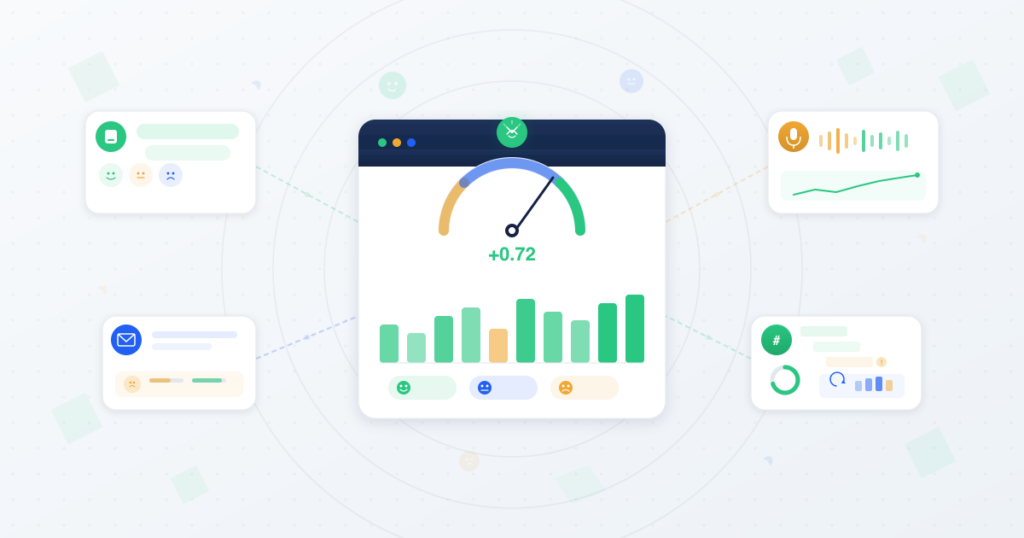
Your customers are talking. Every WhatsApp message, every SMS reply, every USSD session, every voice call. Millions of conversations happen across African enterprises daily.
But here is the problem: most businesses have no systematic way to understand how customers actually feel.
Customer sentiment analysis in Africa demands a different approach. Businesses rely on gut instinct. Manual review of random conversations. Lagging survey scores that arrive weeks after the damage is done. Meanwhile, bad customer service examples pile up undetected.
Customer sentiment analysis changes this. It turns every interaction into a real-time signal — satisfaction, frustration, churn risk, delight. Not a survey. Not a guess. A data-driven read on how your customers feel, right now.
This guide gives you a practical framework for implementing sentiment analysis across the channels African businesses actually use. No Western-centric theory. No email-first assumptions. Just actionable steps for WhatsApp-dominant, multilingual, multi-channel markets.
Sentiment analysis is a critical layer in any customer experience transformation strategy. It is also one of the core capabilities driving AI-powered customer intelligence on WhatsApp across Africa.
What Is Customer Sentiment Analysis? (And Why It Matters More Than CSAT Scores)
Customer sentiment analysis uses AI and natural language processing (NLP) to automatically detect the emotional tone behind customer messages. Every message gets classified: positive, negative, or neutral. Advanced systems go deeper — tagging granular emotions like frustrated, satisfied, confused, or urgent.
Think of it as an always-on emotional radar for your customer base.
Traditional metrics like CSAT (Customer Satisfaction Score) capture a snapshot after the interaction ends. You send a survey. A fraction of customers respond. You get a score days later.
Sentiment analysis works differently. It captures the emotional arc during the interaction. In real time. On the actual words customers use — not a 1-to-5 rating they rush through.
Here is why that matters for African enterprises:
- Unstructured data is your richest source. The WhatsApp messages, voice call transcripts, SMS replies, and social media comments your business receives daily contain more honest customer feedback than any survey.
- Low survey response rates become irrelevant. In markets where customers rarely complete post-interaction surveys, sentiment analysis extracts insight from conversations that are already happening.
- Speed wins. A frustrated customer on WhatsApp right now needs attention right now — not after next month’s CSAT report.
Globally, more than 75% of customer-centric businesses already use sentiment analysis as part of their decision-making process. African enterprises are catching up fast. The question is not whether sentiment analysis matters. It is whether your business is listening.
How Sentiment Analysis Works: AI, NLP, and the Technology Behind It
You do not need a data science degree to understand how sentiment analysis works. Here is the core pipeline.
Three Approaches to Sentiment Analysis
Rule-based analysis matches keywords against predefined lists. Words like “terrible” or “love” trigger positive or negative scores. It is straightforward to set up but brittle — it misses sarcasm, context, and nuance.
Machine learning models are trained on labeled datasets. They learn patterns from thousands of tagged examples and generalize to new messages. More accurate than keyword matching, but they need quality training data.
Deep learning and LLM-based analysis represents the current state of the art. These models understand context, sarcasm, and subtle emotional cues. They handle complex language patterns — including the code-switching and informal spelling common in African customer conversations.
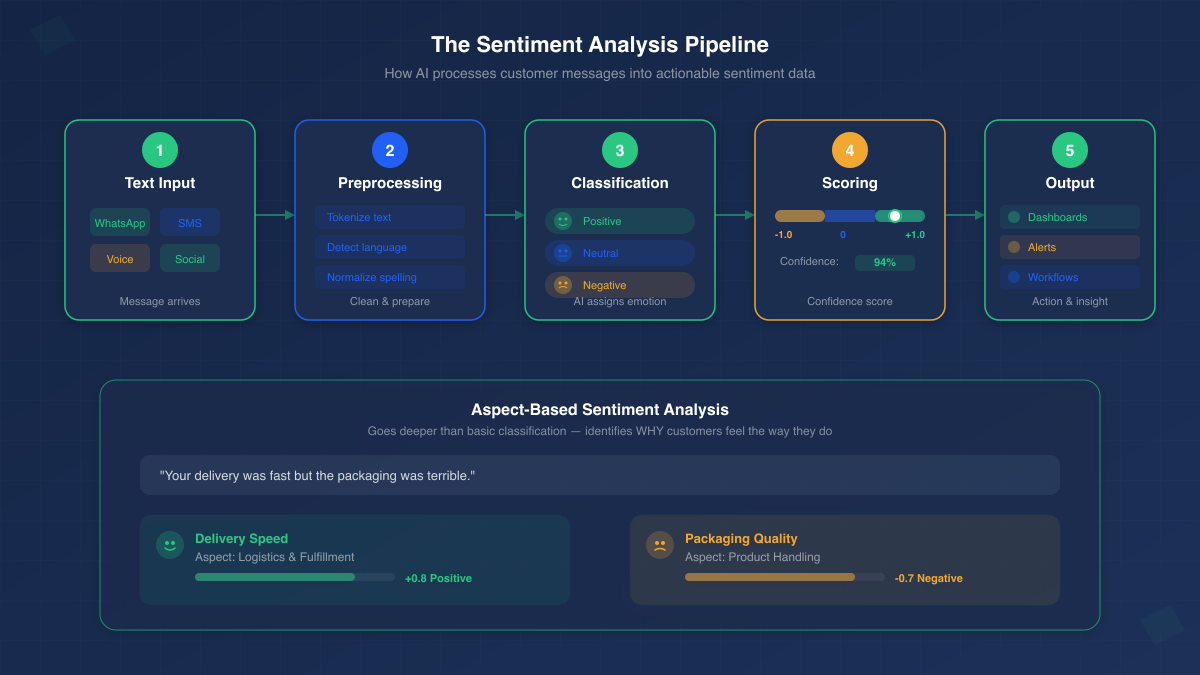
The Sentiment Analysis Pipeline
Every sentiment analysis system follows a similar flow:
- Text input — A customer message arrives via WhatsApp, SMS, voice transcript, or social media.
- Preprocessing — The system tokenizes the text, detects the language, and normalizes spelling variations.
- Sentiment classification — AI assigns an emotional category: positive, negative, or neutral.
- Scoring — The system generates a confidence score, typically on a scale from -1 (very negative) to +1 (very positive).
- Output — Results feed into dashboards, alerts, or automated workflows.
Aspect-Based Sentiment Analysis
Basic sentiment analysis tells you a customer is unhappy. Aspect-based analysis tells you why.
Consider this message: “Your delivery was fast but the packaging was terrible.”
Aspect-based analysis detects two sentiments in one message: positive (delivery speed) and negative (packaging quality). This granularity transforms generic feedback into specific, actionable intelligence.
The African Context: Why Standard Sentiment Analysis Falls Short
This is where every global guide gets it wrong. Standard sentiment analysis tools were built for English-speaking, email-first, Western markets. African enterprises operate in a fundamentally different reality.
Multilingual Code-Switching
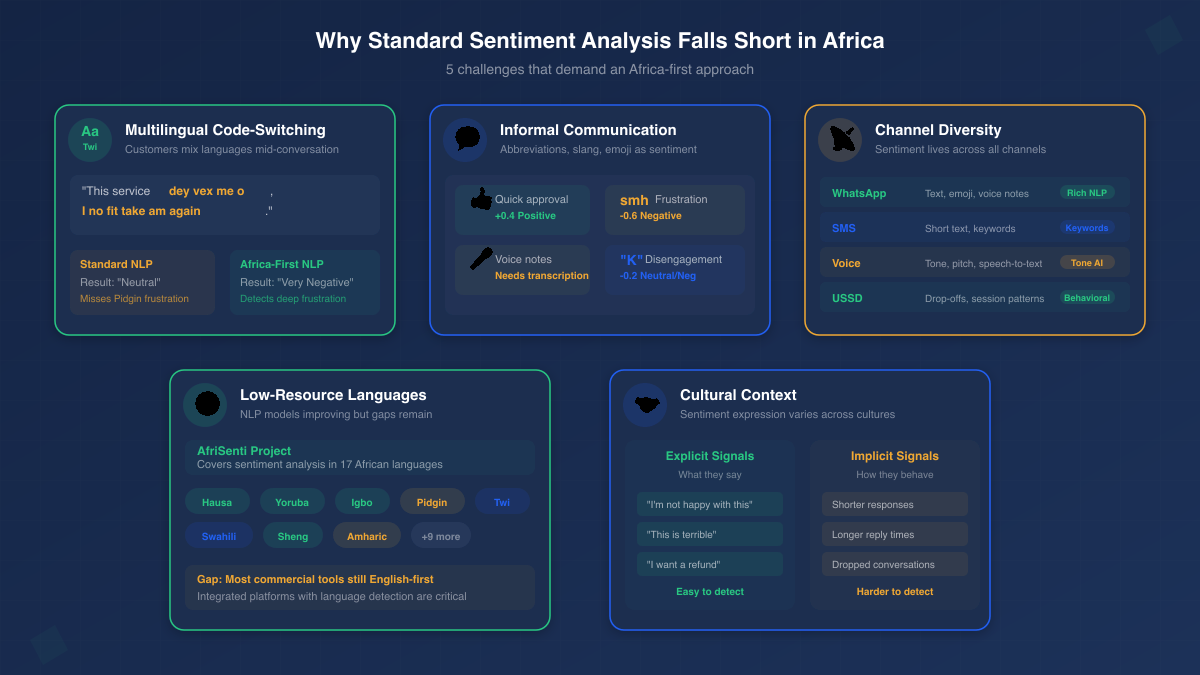
Your customers do not stick to one language. A single WhatsApp conversation might flow between English and Twi, Pidgin and Yoruba, Swahili and Sheng. Standard NLP models trained exclusively on English miss this entirely.
A customer in Lagos might write: “This service dey vex me o, I no fit take am again.” That is Nigerian Pidgin expressing deep frustration — but an English-only sentiment model would classify it as gibberish or neutral.
Informal Communication Styles
WhatsApp messages use abbreviations, local slang, and emoji as primary sentiment markers. Voice notes — dominant in many African markets — need transcription before any text-based analysis can begin.
A thumbs-up emoji after a service interaction means something different than a detailed written complaint. Both carry sentiment signals. Your system needs to read both.
Channel Diversity
African customers interact across WhatsApp, SMS, USSD, voice calls, and social media. Sentiment must be captured across all channels — not just one. A customer who is polite on a voice call might express frustration in a follow-up WhatsApp message. The full picture requires multi-channel analysis.
Low-Resource Languages
NLP models for African languages are improving rapidly. The AfriSenti shared task now covers sentiment analysis in 17 African languages — including Hausa, Yoruba, Igbo, Nigerian Pidgin, and Twi. Google hosts NLP and African languages community workshops at its AI research center in Ghana.
But most African languages remain under-represented in commercial NLP systems. This means off-the-shelf global tools deliver poor accuracy for the languages your customers actually speak.
Cultural Context
Sentiment expression varies across cultures. In some African markets, direct complaints are less common. Dissatisfaction shows up as disengagement — shorter responses, longer reply times, dropped conversations. Your sentiment analysis framework needs to detect these subtle signals, not just explicit negative language.
Channel-by-Channel: Where to Capture Customer Sentiment in Africa
Every customer channel generates sentiment data. Here is how to capture it across the channels African enterprises use most.
WhatsApp: Your Richest Sentiment Source
In countries like Ghana, Nigeria, Kenya, and South Africa, over 70% of internet users frequently use WhatsApp. For many African businesses, WhatsApp is the primary customer channel.
WhatsApp conversations deliver the richest sentiment signals:
- Text messages — Direct emotional expression in natural language.
- Emoji patterns — Repeated positive or negative emoji clusters signal satisfaction or frustration.
- Response time — Customers who reply instantly are engaged. Delayed responses may signal declining interest.
- Conversation length — Extended back-and-forth often indicates unresolved issues.
- Message tone shifts — A customer who starts positive but turns terse is showing real-time sentiment decline.
Capture this data through the WhatsApp Business API, which gives you programmatic access to conversation content. Once your AI chatbot for WhatsApp Business in Africa is handling customer queries, sentiment analysis reveals how customers feel about the experience — automatically, at scale.
SMS: Short Messages, High Signal
SMS messages are brief by nature. But brevity does not mean low value.
Sentiment signals in SMS include:
- Reply sentiment — The tone of customer responses to your campaigns or notifications.
- Opt-out rates — A spike in “STOP” messages signals negative sentiment at scale.
- Keyword patterns — Words like “cancel,” “refund,” or “complaint” flag issues that need attention.
- Response rates — Declining engagement with SMS campaigns may indicate audience fatigue or dissatisfaction.
USSD: Behavioral Sentiment Signals
USSD for business in Africa generates structured interaction data rather than free text. Sentiment analysis here relies on behavioral proxy signals:
- Drop-off points — Where in the menu flow do customers abandon sessions? Frequent drop-offs at a specific step signal confusion or frustration.
- Completion rates — Low completion rates for a service suggest usability issues.
- Session duration — Unusually long sessions may indicate difficulty navigating the menu.
- Repeat sessions — Customers who restart the same USSD flow multiple times are likely struggling.
These behavioral signals feed into your overall sentiment picture even without natural language to analyze.
Voice: Tone Tells the Truth
VoiceConnect call recordings and transcripts reveal sentiment through both words and delivery:
- Speech-to-text transcripts — Convert call recordings into text for NLP-based sentiment analysis.
- Tone analysis — Voice pitch, speed, and volume changes signal frustration or satisfaction.
- IVR navigation patterns — Customers who repeatedly press “0” for an agent or cycle through menus are frustrated.
- Call duration and transfers — Long calls with multiple transfers indicate unresolved issues.
Comparing sentiment across SMS vs voice for business interactions reveals which channel your customers prefer for different types of communication.
Social Media: Public Sentiment at Scale
Facebook, X (Twitter), and Instagram comments and mentions provide public sentiment signals:
- Brand mentions — Track positive and negative mentions in real time.
- Comment sentiment — Analyze the tone of comments on your posts and ads.
- Review analysis — Aggregate sentiment from customer reviews across platforms.
The key insight: each channel captures a different layer of customer sentiment. Omnichannel communication platforms unify these signals into a single view — so you see the complete picture, not isolated fragments.
Ready to track customer sentiment in real time across every channel? Kova IQ’s AI-powered analytics dashboard captures sentiment from WhatsApp, SMS, voice, and more — in one unified view. See how it works.
A 5-Step Framework for Implementing Sentiment Analysis
Here is a practical roadmap for African enterprises — whether you are starting from zero or upgrading from manual processes.
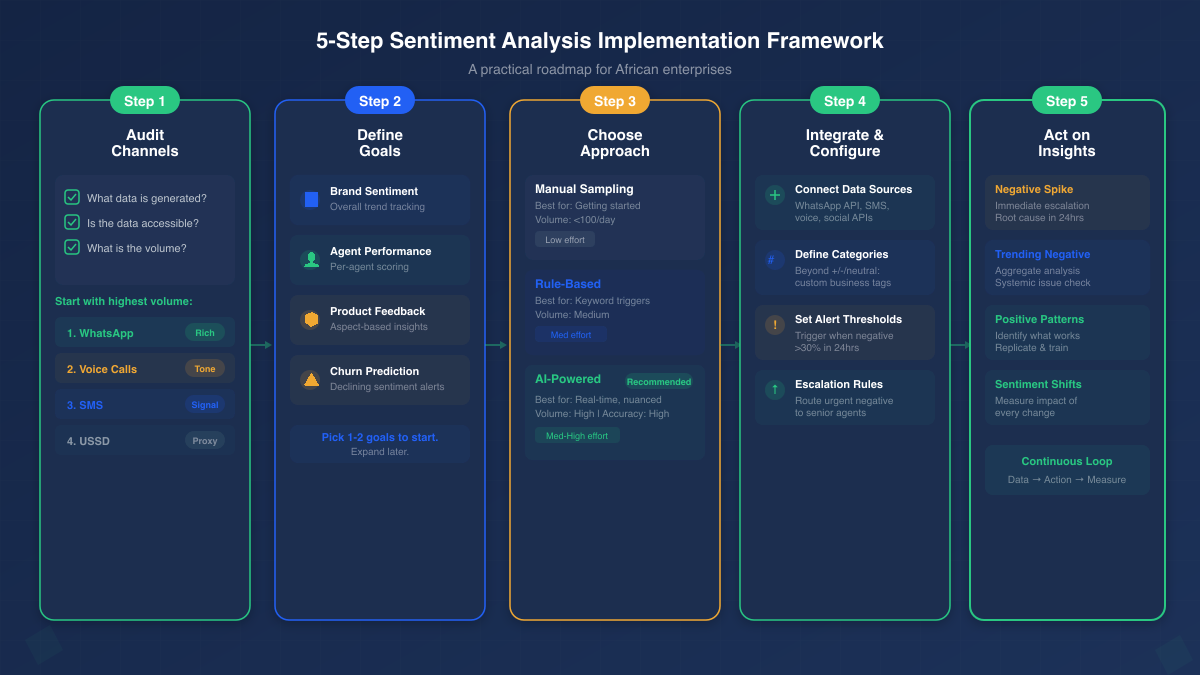
Step 1: Audit Your Customer Channels
Map every touchpoint where customer conversations happen. For each channel, answer three questions:
- What data is generated? (Text messages, voice recordings, structured menu responses, social comments)
- Is the data accessible? (API access, exportable, or locked in a platform you cannot integrate with)
- What is the volume? (Hundreds of interactions per day or thousands)
Most African enterprises will find that WhatsApp and voice calls generate the highest volume and richest data. Start there.
Step 2: Define Your Sentiment Goals
Sentiment analysis is not one-size-fits-all. Your goals determine your approach:
- Brand sentiment tracking — Overall positive/negative/neutral trends over time. Useful for marketing teams measuring campaign impact.
- Agent performance — Per-agent sentiment scores to identify top performers and coaching opportunities.
- Product feedback — Aspect-based sentiment on specific products, features, or services.
- Churn prediction — Declining sentiment patterns that signal a customer is about to leave.
Pick one or two goals to start. You can expand later.
Step 3: Choose Your Approach
Match your approach to your current maturity and conversation volume:
| Approach | Best For | Volume | Accuracy | Setup Effort |
|---|---|---|---|---|
| Manual sampling | Getting started, <100 conversations/day | Low | Depends on reviewer | Low |
| Rule-based automation | Keyword triggers, simple scoring | Medium | Moderate | Medium |
| AI-powered analysis | Real-time, multi-channel, nuanced | High | High | Medium-High |
If you handle fewer than 100 customer conversations per day, start with manual sampling to establish a baseline. As volume grows, move to rule-based triggers. At scale, AI-powered analysis becomes essential.
Step 4: Integrate and Configure
Connect your channels to a unified analytics platform. Key setup steps:
- Connect data sources — WhatsApp Business API, SMS platform, voice call recordings, social media APIs.
- Define sentiment categories — Beyond positive/negative/neutral, configure tags relevant to your business (e.g., “pricing complaint,” “delivery praise,” “onboarding confusion”).
- Set alert thresholds — Trigger notifications when negative sentiment exceeds a defined threshold (e.g., more than 30% negative in a 24-hour window).
- Configure escalation rules — Route high-urgency negative sentiment directly to senior agents or managers.
Step 5: Act on Insights
Data without action is wasted effort. Build response workflows:
- Negative sentiment spike — Immediate escalation to the relevant team. Investigate root cause within 24 hours.
- Trending negative topic — Aggregate analysis to identify systemic issues. Is it a product problem, a process failure, or a specific agent?
- Positive sentiment patterns — Identify what is working and replicate it. Share positive conversation examples in team training.
- Sentiment shifts after changes — Measure the impact of every process improvement, product update, or campaign.
This framework fits naturally into a broader strategy to build a customer experience strategy that is data-driven rather than assumption-driven.
Turning Sentiment Data Into Business Decisions
Measuring sentiment is step one. The real value is in what you do with it. Here are four practical use cases for African enterprises.
1. Churn Prevention
A telecom customer’s WhatsApp messages shift from friendly to terse over three consecutive interactions. Their complaint about network coverage goes unresolved. Sentiment score drops from +0.6 to -0.4 in two weeks.
Without sentiment analysis, this customer churns silently. With it, the system flags the declining trend and triggers a proactive retention outreach — a personalized message via WhatsApp or a call from a senior support agent — before the customer ports their number.
Companies using real-time AI-powered sentiment analysis report up to 25% higher customer retention.
2. Agent Coaching
A Ghanaian e-commerce company tracks sentiment scores across its 50 customer support agents. The data reveals that Agent A consistently scores +0.7 (positive) while Agent B averages -0.1 (borderline negative).
Instead of generic training, the team reviews Agent B’s actual conversations — identifying specific patterns (slow response, unclear answers, missing empathy cues) and using Agent A’s conversations as coaching examples.
This is targeted coaching powered by real data, not subjective manager observations.
3. Product and Service Improvement
A Nigerian fintech aggregates sentiment by topic across all customer channels. The analysis reveals a 40% spike in negative sentiment around “transfer delays” over the past month.
This is not a single complaint. It is a systemic pattern — visible only when sentiment is tracked and categorized at scale. The product team investigates, identifies a backend bottleneck, and resolves it. Negative sentiment drops within a week.
You can see more omnichannel customer experience examples of how multi-channel intelligence drives operational improvement.
4. Campaign Optimization
A Kenyan bank launches a new savings product campaign via SMS and WhatsApp. Sentiment analysis tracks customer reactions in real time — not just click rates, but how customers feel about the messaging.
The data shows positive reception of the product benefits but negative sentiment around the sign-up process. The marketing team adjusts the campaign mid-flight, simplifying the onboarding flow. CSAT scores improve by double digits.
Companies using real-time sentiment analysis report up to 40% faster escalation management and 15-20% improvements in CSAT scores.
Sentiment data is most powerful when it feeds into your customer experience strategy guide as a continuous feedback loop — not a one-time report.
How Kova IQ Delivers Real-Time Sentiment Intelligence
The challenges outlined in this guide — multilingual conversations, multi-channel data, real-time analysis at scale — demand an integrated solution. Not a standalone tool bolted onto your existing stack.
Kova IQ is built for exactly this.
Here is what it looks like in practice: A customer contacts your support team on WhatsApp. The conversation starts positive, but after two unresolved follow-ups, their tone shifts — shorter messages, no greetings, direct demands. Kova IQ detects this sentiment decline in real time. Your agent sees the mood shift flagged in the dashboard before the customer escalates. The system triggers a priority routing rule, and a senior agent steps in with a resolution — turning a potential churn event into a retention win.
That is the difference between reactive support and intelligence-driven customer experience.
AI-powered customer intelligence. Kova IQ uses AI to analyze customer conversations in real time — detecting sentiment, identifying trends, and surfacing actionable insights automatically.
Real-time analytics dashboard. See sentiment trends across your entire customer base at a glance. Drill down by channel, by agent, by topic, by time period. No waiting for weekly reports.
Sentiment analysis across channels. WhatsApp, SMS, voice, social — Kova IQ captures sentiment from every channel your customers use. One platform. One view. No data silos.
Multi-channel interaction tracking. Follow a customer’s sentiment journey across channels. See how their experience on a voice call influences their next WhatsApp message.
Conversation analytics. Go beyond sentiment scores. Kova IQ analyzes conversation patterns — topic clustering, resolution time correlation, escalation triggers — to give you the full intelligence picture.
Customer journey mapping. Map sentiment at every stage of the customer journey. Identify exactly where experiences break down and where they excel.
The difference between Kova IQ and standalone sentiment tools? Kova IQ is built into the same platform that handles your WhatsApp conversations, SMS, and voice. No data export. No third-party integration headaches. No data silos. Sentiment analysis feeds directly into your unified inbox — so agents see customer mood in real time, during the conversation, not after.
Combine Kova IQ’s sentiment intelligence with an AI chatbot for WhatsApp Business in Africa to create automated responses that adapt based on detected customer sentiment.
Understanding how CRM vs. marketing automation systems work together helps you see where sentiment data fits in your broader technology stack.
FAQ: Customer Sentiment Analysis for African Businesses
What is customer sentiment analysis?
Customer sentiment analysis uses AI and natural language processing to automatically detect the emotional tone behind customer messages. It classifies interactions as positive, negative, or neutral — and can identify specific emotions like frustration, satisfaction, or urgency.
How do you measure customer sentiment?
Sentiment is measured by analyzing the actual language customers use across channels — WhatsApp messages, SMS replies, voice call transcripts, and social media comments. AI models assign sentiment scores (typically -1 to +1) based on emotional tone, word choice, and context.
What tools are used for sentiment analysis?
Tools range from standalone NLP platforms to integrated customer intelligence solutions like Kova IQ. The most effective tools for African enterprises are those that support multi-channel analysis (WhatsApp, SMS, voice) and can handle multilingual conversations including African languages.
Can sentiment analysis work with African languages?
Yes, and the technology is advancing rapidly. The AfriSenti research project covers sentiment analysis in 17 African languages including Hausa, Yoruba, Igbo, Nigerian Pidgin, and Twi. However, most commercial tools still perform best in English — making integrated platforms that combine language detection with sentiment analysis particularly valuable.
How does sentiment analysis differ from customer satisfaction surveys?
Surveys capture a single data point after the interaction ends and depend on customers voluntarily responding. Sentiment analysis works continuously on conversations that are already happening — capturing emotional shifts in real time, across every interaction, with no additional effort from the customer.
How much does it cost to implement sentiment analysis?
Costs vary based on approach. Manual sampling requires only staff time. Rule-based systems need initial setup but minimal ongoing cost. AI-powered platforms like Kova IQ offer enterprise-grade sentiment analysis as part of an integrated customer intelligence platform — contact the Arkesel team for pricing tailored to your conversation volume and channels.
See how Kova IQ turns every customer conversation into actionable sentiment intelligence — across WhatsApp, SMS, voice, and more. Get started today or talk to our team about your customer intelligence needs.
Related Articles
- AI Chatbot for WhatsApp Business in Africa: Setup Guide — Build and deploy an AI-powered chatbot for WhatsApp customer interactions across African markets.
- WhatsApp vs SMS vs Voice: Choosing the Right Channel Mix for African Customers — A practical decision framework for building the right WhatsApp, SMS, and voice channel mix for African businesses.
- WhatsApp AI Features for Business in South Africa: What You Can Do in 2026
- WhatsApp Business API in Africa: Setup, BSPs & Pricing 2026

WhatsApp Ticketing System: Turn Chats Into Tickets With SLAs That Fit the 24-Hour Window
A WhatsApp ticketing system turns chats into tickets with owners, statuses and SLA clocks. See how…

Contact Centre CRM Integration: How to Give Agents the Whole Customer Before They Say Hello
Contact centre CRM integration puts a caller's open tickets and WhatsApp history on your agent's screen…

WhatsApp Marketing for Ghana SMEs: 2026 Playbook
WhatsApp marketing Ghana: 2026 SME playbook on Meta template categories, consent (Act 843), payday timing and…


