
What Is an SMS Aggregator? How It Works and How to Choose One
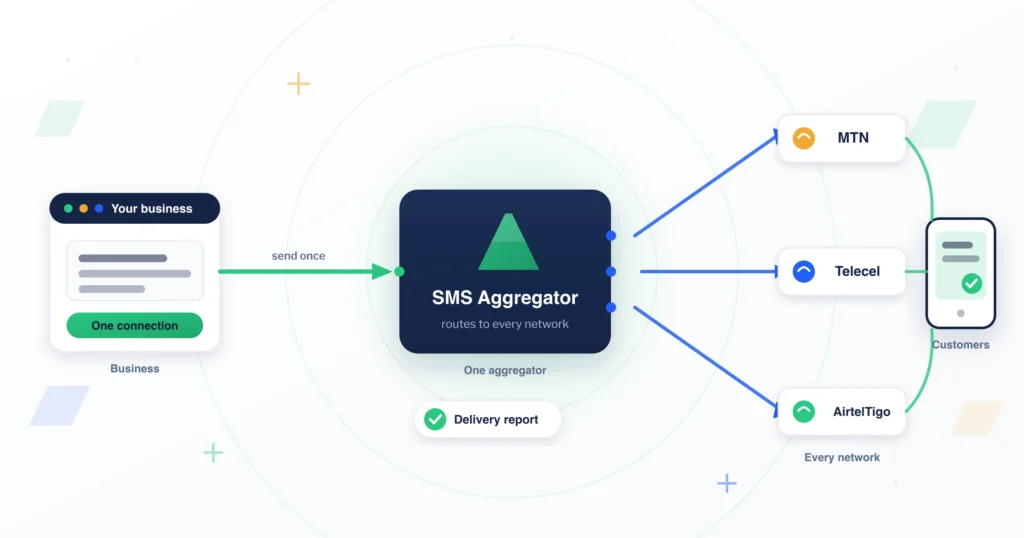
An SMS aggregator is a company that connects businesses to mobile network operators so you can send and receive text messages at scale through a single connection, instead of integrating with every network one by one. It sits between your business and the carriers, routes each message to the right network, and reports back whether it was delivered.
If you keep seeing the term “SMS aggregator” and need to know what it means, how aggregation actually works, and how to choose a reliable one, this guide answers all three. It also covers how the concept plays out in Ghana and across Africa, where SMS still reaches customers no other channel can.
What is an SMS aggregator?
An SMS aggregator is the middleman between businesses and mobile networks. Networks like MTN, Telecel, and AirtelTigo each run their own messaging infrastructure. Connecting to each one directly is slow, technical, and expensive to maintain.
An aggregator solves that. It holds the connections to the networks and gives you one connection in return. You send your messages to the aggregator through a dashboard or an API, and the aggregator delivers them across every network your customers use.
That single point of access is the whole value. One integration, one account, and one delivery report covering MTN, Telecel, AirtelTigo, and beyond. You focus on the message. The aggregator handles the routing.
How does SMS aggregation work?
Aggregation turns one message into a delivered text in a few steps. Here is the path your message takes:
- You send the message. You upload a contact list in a dashboard or fire a request to the aggregator’s API with your text and recipient numbers.
- The aggregator identifies the network. It reads each number and determines which operator it belongs to.
- The aggregator routes the message. It sends the message over its connection to that operator’s messaging center.
- The network delivers it. The operator pushes the text to the customer’s phone, whether that’s a smartphone or a feature phone.
- The aggregator reports back. A delivery report confirms whether each message arrived, failed, or is still pending.
Because it speaks to every operator on your behalf, a mobile aggregator gives you national reach from a single connection. Three things decide how well this works:
- Deliverability — the share of messages that actually reach the phone. Direct network connections deliver more reliably than routes that pass through several intermediaries.
- Coverage — which networks and countries the aggregator can reach. Strong local coverage matters most where your customers are.
- Throughput — how many messages the aggregator can push per second. This decides whether a campaign to a million contacts goes out in minutes or drags on for hours.
Direct network connections vs reseller routes
How an aggregator connects to the networks changes everything about delivery. A direct connection means the aggregator has its own agreement with the operator and sends straight to that network. A reseller route passes your message through one or more middle parties before it reaches the carrier.
Each extra hop adds a point where messages can be delayed, throttled, or dropped, and a layer that can obscure why a message failed. Direct connections give you faster delivery, higher deliverability, and clearer reporting when something goes wrong.
Aggregator vs reseller vs gateway
These three terms get used interchangeably, but they describe different things. Here is the distinction in plain terms:
| Term | What it is | What it means for you |
|---|---|---|
| SMS aggregator | A company with direct connections to multiple mobile networks that sends messages on your behalf | One integration reaches every network; best deliverability and reporting when the connections are direct |
| SMS reseller | A business that resells another provider’s messaging routes under its own brand | You depend on the underlying provider’s quality; more hops can mean weaker delivery and less visibility |
| SMS gateway | The software or API endpoint your message passes through to enter the mobile network | The technical access point — most aggregators give you a gateway (an API) to send through |
The short version: an aggregator is the company and its network relationships, a reseller resells someone else’s route, and a gateway is the technical doorway you send through. A strong aggregator with direct connections gives you all three in one — the relationships, the route, and the API.
Tier-1 vs Tier-2 aggregators
Aggregators are often grouped into two tiers based on how they connect to the networks. Tier-1 aggregators hold direct connections to mobile network operators, which gives the fastest, most reliable delivery and more control over routing. Tier-2 aggregators route through third parties and lack direct carrier relationships.
The practical takeaway is simple. The closer your aggregator sits to the network, the better your messages perform. Fewer hops mean fewer points of failure, quicker delivery, and cleaner delivery data.
Why SMS aggregators matter in Ghana and Africa
Every global guide to SMS aggregators explains the concept with US and UK carriers. None of them speak to the reality on the ground in Ghana and across Africa — and that reality is exactly why aggregators matter here.
Start with reach. As reported by DataReportal’s Digital 2026: Ghana report, citing GSMA Intelligence, Ghana had 41.8 million cellular mobile connections at the end of 2025 — equivalent to 119% of the total population, because many people carry more than one SIM.
The report adds that some of those connections may only carry services such as voice and SMS, with no internet access. For a text message that is not a limitation — a voice-and-SMS line receives it exactly like a smartphone does. Nearly everyone is reachable by text.
The internet tells a different story. The same report, drawing on Kepios analysis, counts 26.3 million internet users in Ghana at the end of 2025 — a 74.6% penetration rate, which leaves roughly 25% of the population offline. That share is hard to reach through apps, social media, or email, but a text message lands on every one of their phones.
That’s the case for SMS, and for aggregators. SMS reaches the smartphone owner and the feature-phone owner alike, online or off. An aggregator with direct connections to MTN, Telecel, and AirtelTigo is what lets a business turn that reach into delivered messages at scale.
SMS also reads and converts far more reliably than email in this market — it arrives instantly, needs no data plan, and gets seen. If you’re planning campaigns, our complete guide to SMS marketing in Ghana covers the strategy side in depth.
How to choose a reliable SMS aggregator
Not every aggregator delivers the same results. Use this checklist to compare your options and choose one that performs where it counts:
- Direct network connections and deliverability. Confirm the aggregator connects directly to the operators your customers use. Direct connections mean higher delivery rates and faster sends.
- Coverage. Check that it covers every network and country you need to reach, with strong local coverage in your core market.
- Scale and throughput. Make sure it can push your peak volumes — a festive campaign to hundreds of thousands of contacts shouldn’t crawl.
- Real-time delivery reporting. You need to see which messages landed and which failed, as they happen, so you can act on the data.
- Support. Look for responsive, in-market support that understands local networks and can resolve routing issues fast.
- Compliance. The aggregator should support sender ID registration, consent handling, and the messaging rules in your market.
When you’re ready to compare specific vendors head to head, our comparison of the top bulk SMS providers ranks them on these exact criteria, and our roundup of the best bulk SMS providers in Ghana narrows it to the local market.
Ready to send through a direct-connect aggregator? See how the Arkesel SMS Platform delivers messages through direct connections to MTN, Telecel, and AirtelTigo.
How Arkesel works as a direct-connect SMS aggregator
Arkesel is a direct-connect SMS aggregator built for Africa. The SMS Platform holds direct connections to MTN, Telecel, and AirtelTigo, so your messages reach the network without passing through extra hops that slow delivery and hide failures.
You get one integration that scales to millions of messages, real-time delivery tracking that shows you exactly what landed, and a REST API for developers who want to send straight from their own systems. It’s the Tier-1 setup the checklist above describes, applied to the African market.
Pricing scales with your volume and message type. See current plans on the Arkesel pricing page.
How to become an SMS aggregator
Most people searching “SMS aggregator” want to send messages through one. A smaller group wants to operate as one. Becoming an aggregator is a serious telecommunications undertaking, not a passive side venture — it rests on regulatory approval and direct telco partnerships. Here’s the real picture.
- Understand the regulatory landscape. Messaging is regulated. In Ghana that means working within the National Communications Authority’s rules; other markets have their own regulators. Sender ID registration, consent, and data-protection obligations all apply.
- Secure telco partnerships. The defining feature of a true aggregator is direct connections to mobile operators. Establishing those agreements with MTN, Telecel, AirtelTigo, and their equivalents across borders is the hardest and most important step.
- Build the infrastructure. You need messaging infrastructure that routes reliably, handles high throughput, and reports delivery accurately — plus an API and dashboard for your clients.
- Meet compliance and quality standards. Operators and regulators expect dependable routing, fraud controls, and clean sender management before they trust you with traffic.
- Serve clients reliably. Aggregation is a service business. Deliverability, uptime, and support are what keep clients and earn the next telco agreement.
For most businesses, the faster path is to send through an established direct-connect aggregator rather than build the network relationships from scratch.
Frequently asked questions
What is an SMS aggregator? An SMS aggregator is a company that connects businesses to multiple mobile networks so they can send and receive text messages at scale through a single connection, instead of integrating with each network individually. It routes your messages to the right network and reports whether they were delivered.
How does SMS aggregation work? You send your message to the aggregator through a dashboard or API. The aggregator identifies which network each number belongs to, routes the message over its connection to that operator, the network delivers it to the phone, and a delivery report confirms the outcome.
What is the difference between an SMS aggregator and a reseller? An aggregator holds direct connections to mobile networks and sends messages on your behalf. A reseller resells another provider’s routes under its own brand, which adds hops between you and the carrier and can mean weaker delivery and less visibility.
What is a Tier-1 vs a Tier-2 SMS aggregator? A Tier-1 aggregator holds direct connections to mobile network operators, giving faster, more reliable delivery and more routing control. A Tier-2 aggregator routes through third parties without direct carrier relationships.
How do I choose a reliable SMS aggregator? Check for direct network connections and high deliverability, coverage of the networks and countries you need, throughput that handles your peak volumes, real-time delivery reporting, responsive local support, and compliance with your market’s messaging rules.
Reach every customer through a direct-connect aggregator
An SMS aggregator is what turns one message into delivered texts across every network your customers use — and in Ghana and Africa, where SMS reaches people no app can, the connections behind your aggregator decide the result. Choose one with direct network connections, real-time reporting, and the scale to handle your volume.
Start sending with the Arkesel SMS Platform and reach your customers reliably.

How to Send Automated Birthday SMS to Your Customers
How to send birthday SMS to customers automatically: the group setup, the 08:00 daily run, the…

How to Become a Bulk SMS Reseller in Ghana: The Business Model and What to Ask a Supplier
How to become a bulk SMS reseller in Ghana: how wholesale capacity works, 8 questions to…

Bulk SMS in Tanzania: What Businesses Need to Know Before Choosing a Provider (2026)
Choosing a bulk SMS provider in Tanzania? Compare network reach, deliverability, sender ID compliance, and API…


