Scheduled SMS marketing solves this by automating messages so your promotions, reminders, and confirmations reach customers at the exact moment they are most likely to respond.
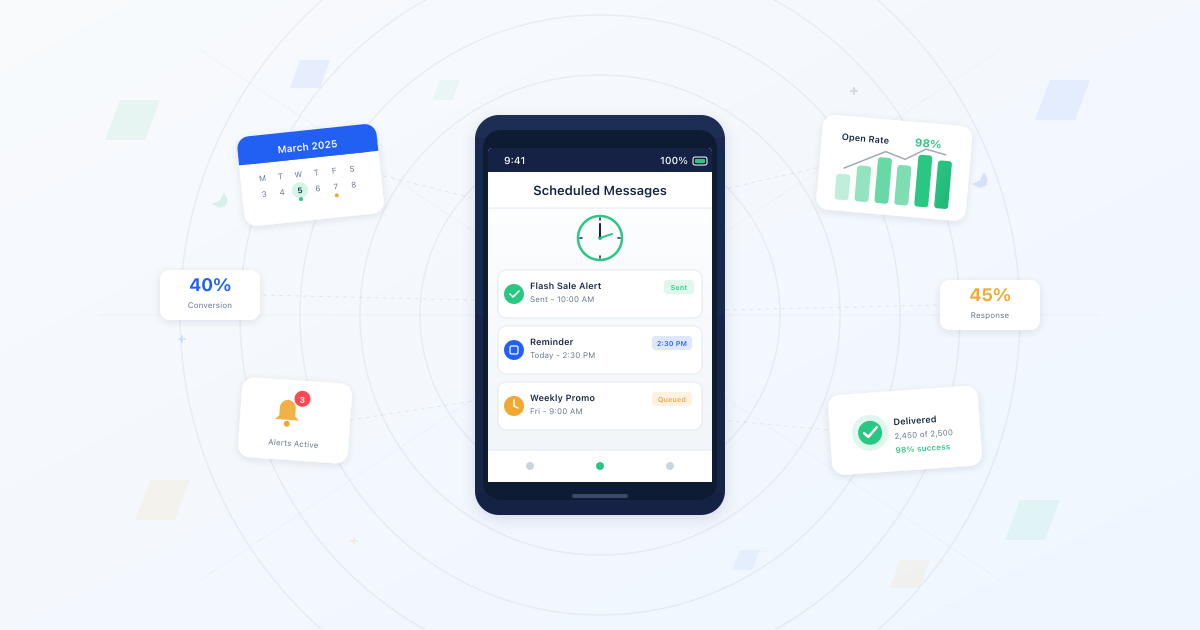
With an open rate of 98%, about 20 times that of email, scheduled SMS delivers strong results, including 21–40% conversion rates and up to 45% response rates.
This article explores how scheduled SMS marketing helps you maintain consistent engagement, increase retention, and scale your communication with ease, no matter the message you need to send.
Why scheduled SMS marketing matters for customer engagement in 2025
Scheduled SMS marketing is more than sending one-off messages; it’s about timing your communication to match customer behaviour so occasional interactions turn into continuous engagement.
With automated scheduling, you no longer have to guess when your message will be seen or acted on.
You simply set it for the most effective moment, early mornings for reminders or evenings for promotions, so your messages land when customers are most responsive.
Key benefits
Improved personalization and relevance:
Sending messages at the right moment, such as right after a purchase, increases engagement.
Studies show that personalized SMS can boost conversions by 22%.
Better scalability:
For businesses sending thousands of messages daily, scheduling removes bottlenecks.
You can plan campaigns weeks ahead, giving your team more time for creative work.
Higher ROI and retention:
Consistent, scheduled communication increases interaction frequency.
The average number of sessions per user can rise by 52%, leading to repeat business.
In fact, 79% of subscribers are more likely to buy again after opting in.
Compliance and trust:
Automated scheduling helps you comply with regulatory requirements and maintain customer trust over time.
Step-by-step guide to setting up scheduled SMS marketing (With Arkesel tools)
Setting up scheduled SMS marketing is straightforward, especially with platforms that support automation.
The process below helps you get started in a scalable, compliance-ready way.
Step 1: Choose a reliable SMS platform
Every campaign begins with the right tool. Select a platform that supports automation, scheduling, analytics, segmentation, and time-zone settings to avoid off-hour sends that increase opt-outs.
Arkesel’s API-first SMS gateway integrates seamlessly with CRMs and e-commerce systems, allowing unlimited promotional and transactional sending.
Create an account to access a simple, easy-to-navigate dashboard. Also, confirm that the platform meets TCPA requirements or the legal standards in your region, and that it supports high-volume short codes.
Step 2: Build and segment your contact list
You cannot run SMS campaigns without a quality audience. Follow proper opt-in practices to stay compliant and protect customer privacy. Avoid purchased lists, as they often lead to high churn.
Opt-in strategies:
Place SMS sign-up forms on your website or app. Use text-to-join keywords like “TEXT JOIN to 12345,” or capture in-store sign-ups with QR codes using Arkesel forms.
Segmentation:
Group subscribers by demographics, behavior, or location. For example, schedule weekend promotions for urban customers. Dynamic tags on Arkesel make filtering easy.
Quality over quantity:
A list of 1,000 targeted subscribers will outperform a list of 10,000 cold contacts. Well-optimised lists can achieve up to 70% opt-in rates.
Step 3: Craft short, compliant messages
Keep SMS messages under 160 characters. Add a clear CTA such as “Reply YES to claim 20% off,” and include your brand name.
Best practices:
Use names and purchase history to personalize messages, for example, “Hey Grace, your favorite sneakers are back in stock!” Add links for tracking engagement.
Compliance:
Include opt-out instructions (“Text STOP to unsubscribe”), avoid sensitive details, and follow data-protection requirements.
Testing:
Run A/B tests on message variations or timing to find what performs best.
Step 4: Set up scheduling and automation
This is where scheduled SMS becomes powerful. Use your platform’s calendar to schedule messages in advance.
Basic scheduling:
Compose your message, select your audience, pick a date and time, and schedule it. Arkesel handles bulk delivery and time-zone adjustments automatically.
Advanced automation:
Trigger SMS for events like abandoned carts, 5-minute follow-ups, or send birthday messages.
Step 5: Launch, monitor, and optimize
Send or schedule your messages, then track performance. Key metrics:
- Open rates: aim for 98%
- CTR: target 21–35%
- Conversions: track purchases or actions
Analytics:
Arkesel’s dashboard provides real-time delivery stats and revenue attribution.
Optimization tips:
- If opt-outs exceed 1.5%, reduce frequency.
- Send appointment reminders 24 hours before the event to reduce no-shows by up to 86%.
- Combine SMS with email and social channels for stronger reach.
Best practices for consistent customer engagement
These proven practices help build trust and increase purchase likelihood by up to 87% among SMS subscribers.
- Timing: Send between 9 a.m. and 8 p.m. local time. Avoid holidays unless running a promotion.
- Frequency: Stick to 4–6 messages per month to prevent fatigue.
- 80/20 mix: Keep 80% of your SMS focused on value and updates, and limit sales-heavy messages to 20%.
- A/B testing: Test CTAs or emojis to boost response rates.
- Cross-channel integration: Enhance scheduled SMS with richer customer engagement using Arkesel’s WhatsApp API.
How scheduled SMS marketing boosts ROI and customer value
With the help of automation, personalization, and the right timing, you can maximize ROI with scheduled SMS marketing.
- Scheduling SMS messages that resonate with your audience can increase conversions, sales, and customer loyalty.
- When done properly, scheduled SMS marketing can become an impressive tool in your marketing toolkit, delivering amazing ROI and a shot in the arm for your business.
- Sending targeted messages at the right time will help you increase engagement, site traffic, and revenue.
- Additionally, scheduled SMS marketing enables you to automate your communication process, saving time and resources while maintaining consistent customer engagement.
Enhancing business growth with scheduled SMS marketing
Scheduled SMS marketing goes beyond sending texts; it creates consistent touchpoints that keep your brand top of mind, reduce churn, and support long-term growth. With high open rates and strong conversion performance, it’s becoming a valuable channel for businesses that want to scale in competitive markets across Africa.
To simplify automation and improve engagement, Arkesel provides an SMS gateway with easy setup, 99.9% uptime, and local expertise to help businesses run reliable, high-performing campaigns.
FAQs
Q.1 What is the average open rate for scheduled SMS marketing?
Scheduled SMS messages have a 98% open rate, as recipients check texts within minutes, according to industry reports’ 2025 benchmarks.
Q. 2 What are the best times to schedule SMS for maximum engagement?
Aim for 9 am to 8 pm local time with peaks in early mornings for reminders. Reports show that conversions peak within 15 minutes of sends for digital brands.
Q.3 How much does the SMS marketing industry grow annually?
The market is expected to grow at a 20.3% CAGR, reaching $12.6 billion by 2025, according to Grand View Research.