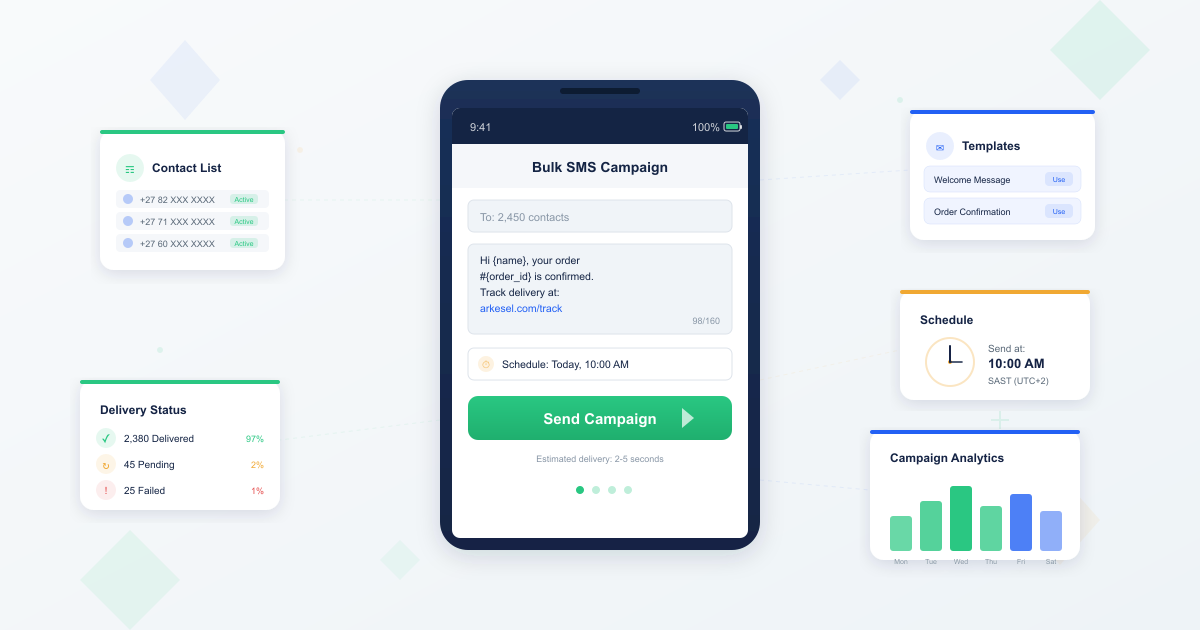
Bulk SMS in South Africa helps businesses reach customers instantly at a low cost.
You need to send a message to many people, and you need them to read it.
Email feels too slow. Phone calls take too much time.
Your team needs a faster and more direct way to reach customers, staff, or partners across South Africa.
Bulk SMS is the obvious choice. But knowing how to send Bulk SMS correctly is where most businesses get stuck.
This guide explains how to send bulk SMS in South Africa with clarity and compliance.
From choosing a reliable platform to understanding local regulations, it provides a practical roadmap to deliver, read, and act on your messages.
What is bulk SMS?
Bulk SMS is the practice of sending a single text message to a large group of recipients at once using a web platform or SMS gateway.
It is commonly used by businesses in South Africa to share updates, promote offers, confirm appointments, and communicate internally.
Unlike personal messaging, bulk SMS is built for scale, allowing you to reach hundreds or thousands of people quickly, reliably, and without the need for internet access on the recipient’s end.
Use cases to send bulk SMS in South Africa for B2B businesses
Sending bulk SMS is a practical tool for business communication across many industries.
Common use cases include:
- Payment reminders to reduce late transactions
- Appointment confirmations for service-based businesses
- Product launch announcements to generate interest
- Internal communication, such as meeting alerts and shift updates
- Customer service notifications like ticket updates or delivery tracking
- Emergency alerts to quickly reach staff or clients during disruptions
- Usage notifications and service downtime alerts in the telecommunications industry.
Benefits of bulk SMS in South Africa
Bulk SMS is not just a tool; it is a direct link to your audience.
In a mobile-first country with limited internet access, SMS delivers your message instantly, no apps, no data, just results.
1) High open rate:
People do not ignore SMS. They check their messages fast.
Most open it within minutes. It is short. It is clear. It lands directly in the inbox.
In South Africa, where people use phones more than email, that matters.
2) Works without the internet:
Some areas in South Africa still struggle with network coverage.
Rural towns, farming communities, and some informal settlements face poor internet access.
Bulk SMS does not need Wi-Fi or mobile data.
3) Tracks delivery:
You know what gets through. You know what does not.
Bulk SMS tools show you who received the message. You can track delivery rates.
4) Costs less:
Budgets are tight. Bulk SMS helps you reach many people at a lower cost.
You do not pay for internet ads. You do not build landing pages.
You just send a message. It is simple. It is effective.
5) Works on all phones:
You do not need a smartphone. You do not need a browser.
Bulk SMS works on any mobile phone. Even the most basic phone receives it.
6) Feels personal:
You can include the name of the person. You can include unique details.
That creates trust. That builds a connection.
People respond more when a message feels personal.
Bulk SMS makes that possible.
How to send bulk SMS in South Africa (With tips that work)
Sending bulk SMS is more than clicking send.
Each step is a chance to connect, not just deliver.
Below is how to do it the right way.
1) Understand your audience:
Before you send anything, pause.
Who is your message for? Teachers? Shop owners? Youth in rural areas?
Know this first. It shapes your words. It shapes your tone. Speak directly.
Use what they understand.
2) Choose a trusted bulk SMS platform that works in South Africa:
Look for one with delivery reports, support for local networks, and good uptime.
Avoid flashy extras. You want speed, reach, and clear delivery.
Arkesel fits here. It connects well with MTN, Vodacom, Telkom, and Cell C.
3) Write a short, clear message:
Say what matters. Say it fast. Keep it under 160 characters.
Begin with the key point. Skip fancy words. Short messages hit harder and cost less.
4) Add a strong call to action:
End with a clear move. “Call this line.” “Visit this store.”
“Reply YES to join.” Do not assume they will figure it out.
Say it. Make it plain; one action per message.
5) Schedule for the right time:
Timing matters. Avoid work hours. Try early morning or late evening.
People check their phones before bed and when they wake up.
Send when they are not busy. Test different times and stick to what works.
6) Personalize when you can:
Use names if your platform allows it. “Hello Thandi” feels better than “Dear Customer.”
People respond to what feels made for them. Just keep it natural.
7) Follow SMS laws:
South Africa has rules. Get consent. Let people opt out.
Avoid spammy words. Clean messages build trust.
Skipping this breaks the law and the link with your audience.
8) Test and measure:
Try two versions: track clicks or replies. Drop the low performers.
Keep what works. Test again. This is how you improve without guessing.
Regulatory requirements of bulk SMS in South Africa
Sending bulk SMS in South Africa involves more than using a messaging platform.
Businesses must follow legal guidelines to protect user data and ensure compliance.
1. Protection of Personal Information Act (POPIA) Compliance
The Protection of Personal Information Act (Act No. 4 of 2013), commonly known as POPIA, governs how businesses collect, store, and use personal data in South Africa.
When using bulk SMS, businesses must obtain clear and voluntary consent before sending any communication.
This applies to promotional messages, transactional alerts, and internal updates.
Recipients must also be given a simple way to opt out of future messages.
Ignoring these requirements can lead to legal penalties and damage to brand reputation.
Compliance with POPIA ensures that your SMS campaigns are both ethical and legally sound.
2. Regulation of Interception of Communications and Provision of Communication-Related Information Act (RICA)
The Regulation of Interception of Communications and Provision of Communication-Related Information Act (Act No. 70 of 2002), referred to as RICA, requires mobile communication to be traceable.
For businesses using bulk SMS, this often means registering a sender ID that identifies the source of the message.
While some platforms offer shared sender names, a custom or branded sender ID usually requires approval and verification.
Using a registered and approved sender ID increases trust, improves delivery rates, and prevents your messages from being flagged as spam.
What to look for in a bulk SMS provider
When choosing a bulk SMS platform in South Africa, consider these key features:
1) Delivery rate:
Pick a provider known for high deliverability.
Ensure they can handle South African networks reliably.
2) Ease of use:
Look for a platform with a clean dashboard.
It should allow fast scheduling and simple report access.
3) API Integration:
Automation is vital. Confirm the platform offers a stable, well-documented API.
4) Compliance support:
South African law requires strict data protection.
Your provider should help you stay compliant with POPIA and RICA.
5) Scalability:
Your needs may grow. The platform should handle higher volumes without glitches.
6) Regional adaptability:
The provider must support South African needs, whether local or international.
This includes ZAR billing, regional routes, and local messaging patterns.
Who uses bulk SMS in South Africa?
Bulk SMS is not for one industry. It fits into many.
From the corner shop to the corporate tower, people use it to stay in touch, share news, and get results.
1) Schools and universities:
They send class schedules. They send exam dates.
They send fee reminders. Parents get quick updates. Students stay informed; no missed notices.
No delay. It keeps the school community in sync.
2) Health care providers:
Clinics use it for appointment reminders. Hospitals send alerts during outbreaks.
Pharmacies share refill notices. Patients do not miss care.
It improves health outcomes. It saves lives.
3) Religious groups:
They send worship times. They announce events. They follow up on new members.
Everyone gets the same message. Everyone feels included. It builds unity.
4) Small and medium businesses:
They promote new offers. They remind customers about orders.
They follow up on payments.
5) Government and NGOs:
They send public alerts. They spread awareness. They reach rural communities.
When quick action is needed, SMS delivers. No internet required.
Just the message and the phone.
6) Events and entertainment:
Organizers use it for invitations. They send updates on venues and time.
Ticket buyers get reminders. Attendees get real-time alerts.
It helps events run smoothly.
Mastering delivery for bulk SMS in South Africa
Sending bulk SMS in South Africa is simple.
No need for tech skills or costly software, just a clear goal, a strong message, and a reliable platform.
Whether it is a small business or a large one, the process stays the same: know the audience, craft the message, choose the right provider, test, send, and track.
Bulk SMS reaches people fast. It lands directly on phones, even basic ones.
It works when emails are ignored or when data runs out.
Ideal for reminders, alerts, or promotions, it keeps people informed and delivers the message every time.