
The Effectiveness of Email Marketing: ROI, Impact & How to Measure It
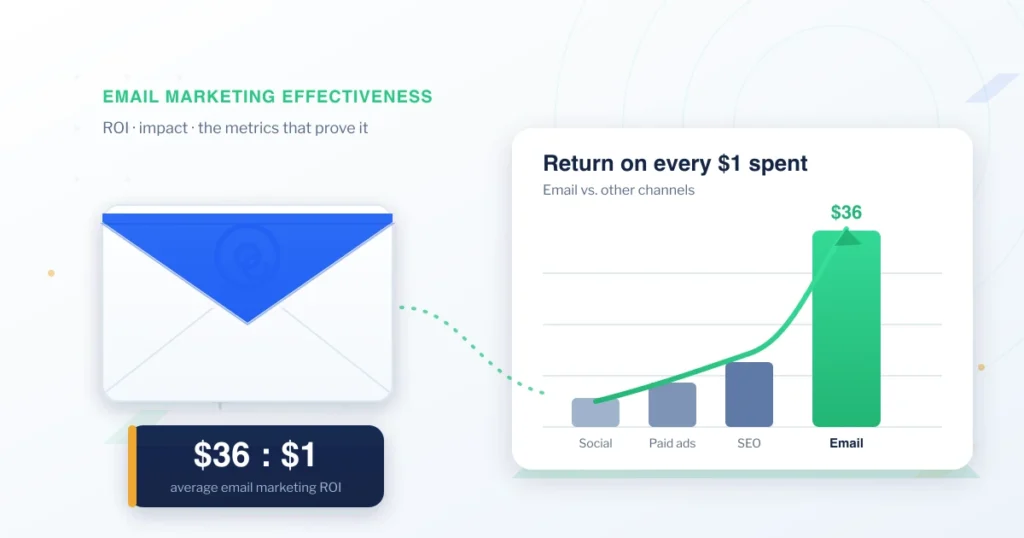
Marketers keep asking the same question: with social media, influencers, and paid ads everywhere, is email marketing still effective? The short answer is yes. Email remains one of the highest-return channels a business owns — and unlike rented audiences on social platforms, your email list belongs to you.
This guide answers the email marketing effectiveness question directly, shows the impact email marketing has on business growth, and walks through the exact metrics that prove it is working.
Is email marketing effective in today’s digital world?
Yes. Email marketing is highly effective and remains one of the strongest channels for return on investment. On average, email marketing drives an ROI of $36 for every $1 spent — higher than any other channel — according to Litmus, based on its survey of marketing professionals.
That figure is a global industry benchmark, not a guaranteed return. The honest picture is a range: Litmus reports that email ROI sits between 10:1 and 36:1 for most companies, with 35% of companies seeing $10 to $36 back for every $1 spent. Where your program lands inside that range depends on how well you segment, automate, and measure — which is what the rest of this guide covers.
Email stays effective because it combines three things no other channel does at once: direct access to the inbox, an audience you own outright, and measurable results you can act on in real time.
Why email marketing remains effective
Newer channels come and go. Email keeps delivering for three durable reasons.
You own the audience. Your followers on a social platform belong to that platform. Its algorithm decides who sees your post, and a rule change can erase your reach overnight. Your email list is yours. You reach every subscriber directly, no gatekeeper in between.
It lands in the inbox. Email goes straight to a personal, checked-daily space. A weekly newsletter, a promotional offer, or a transactional update reaches your audience without competing for a slot in a feed.
The cost advantage is real. Paid ad costs keep climbing, and you pay again for every impression. Email lets you reach an audience you already earned, at a far lower barrier to entry than buying that attention through ads. For a growing business watching every cedi, that owned-channel economics is the whole argument.
The impact of email marketing on business growth
Effectiveness only matters if it moves the business. Here is how email marketing shows up on the bottom line.
Retention and repeat purchase. Acquiring a new customer costs far more than keeping an existing one. Consistent, relevant email keeps your brand top of mind, brings customers back, and turns a single purchase into a repeat relationship.
Sales and conversions. A timely promotion, a product launch, or a personalized recommendation drives direct sales. Abandoned-cart reminders recover revenue that would otherwise walk away — a gentle nudge that brings shoppers back to finish checkout.
Customer acquisition. Lead magnets, sign-up offers, and welcome sequences widen your audience and convert first-time visitors into subscribers you can nurture toward a sale.
Brand trust. When customers see your brand in their inbox with content that actually helps them, trust compounds. Educational emails — useful tips, industry insight, product guidance — position your business as the authority in your space.
The levers behind effectiveness
Email does not perform on its own. Effective programs pull a few specific levers, and these are exactly where an email marketing platform earns its place.
Segmentation. Split your list by behavior, preferences, or purchase history and send each group content that fits. Targeted emails consistently outperform a single message blasted to everyone.
Automation by event type. Welcome series, post-purchase follow-ups, win-back campaigns, and birthday offers run on their own once you set them up — timely, relevant, and zero manual effort per send.
Transactional and reminder emails. Order confirmations, payment receipts, and appointment reminders are opened far more than promotions because the reader is expecting them. They build trust and keep customers informed at the moments that matter most.
A/B testing. Test subject lines, content, and calls to action against each other, keep what converts, and refine continuously instead of guessing.
Arkesel Email Marketing gives you the segmentation, automation, and reporting that turn the effectiveness of email into measurable results — built for African businesses, with reliable deliverability behind every send.
Ready to put these levers to work? Arkesel Email Marketing gives you the segmentation, automation, and reporting to design, send, and measure campaigns that convert.
How to measure email marketing effectiveness
Effectiveness is not a feeling — it is a set of numbers. These are the metrics that prove email marketing is working for you:
- Open rate — the share of recipients who open your email. It tells you whether your subject line and sender name earn attention.
- Click-through rate (CTR) — the share who click a link inside. It shows whether your content and offer are compelling enough to act on.
- Conversion rate — the share who take the action you wanted: a purchase, a sign-up, a download. This is the truest measure of campaign effectiveness.
- Revenue per send — the total revenue a campaign generated divided by the number of emails delivered. It connects email directly to money earned.
- Bounce rate and unsubscribe rate — the health signals. Rising bounces or unsubscribes warn you that list quality or relevance is slipping before it costs you reach.
Track these consistently and email marketing effectiveness stops being a question — the numbers answer it for you. The numbers also tell you exactly what to fix — a low open rate points to subject lines, a low conversion rate points to the offer or landing page.
Email marketing for Ghanaian and African businesses
The effectiveness case is even stronger for businesses in Ghana and across Africa, for two reasons.
First, paid reach is expensive and getting more so, while an owned email list costs you nothing to message again. For an SME, that owned-audience economics is often the difference between marketing that scales and marketing that drains the budget.
Second, your audience is mobile-first. Most subscribers will open your email on a phone, so mobile-friendly design, short copy, and a single clear call to action are not optional — they are how you win the open and the click.
If you are still mapping out the fundamentals, start with how email marketing works, then put the right structure in place with the essential business emails that drive engagement. Strong results also depend on a clean, engaged list — see our guidance on managing your email marketing list and the wider set of email marketing best practices.
Frequently asked questions
Is email marketing still effective?
Yes. Email marketing remains one of the highest-ROI channels available, and because you own your list, your reach is not at the mercy of a social platform’s algorithm. Done well — with segmentation, automation, and consistent measurement — it continues to drive retention, sales, and growth.
What is the ROI of email marketing?
On average, email marketing ROI works out to $36 returned for every $1 spent, according to Litmus. That is a global industry benchmark; actual returns fall in a range, with most companies seeing between 10:1 and 36:1 depending on how effectively they run their program.
Why is email marketing effective?
Email combines direct inbox access, an audience you own rather than rent, and measurable, real-time results. Together those let you reach the right people, at lower cost than paid channels, and improve continuously based on the data.
How do you measure the effectiveness of email marketing?
Track open rate, click-through rate, conversion rate, and revenue per send, and watch bounce and unsubscribe rates as health signals. Together these metrics show whether your emails earn attention, drive action, and generate revenue.
Getting started
Email marketing remains one of the most effective channels you can run — it reaches the audience you own, drives retention and sales, and proves its value in metrics you can measure. The businesses that win with it segment carefully, automate the right moments, and track the numbers that matter.
Related Articles
Start with Arkesel Email Marketing to design, automate, and measure campaigns that convert — and see plans for every stage of growth at Arkesel’s pricing page.

Email List Segmentation: How to Segment Your List for Higher Conversions
Email list segmentation for African marketers: the segments to build first, a decision table, list hygiene,…

How to Combine SMS, WhatsApp and Email Marketing in Africa
How to combine SMS, WhatsApp and email marketing in Africa: which channel carries which message, a…

5 SMS Campaigns Ghanaian Businesses Should Run This Easter
Easter is one of the busiest seasons for businesses in Ghana. Retail stores, restaurants, hotels, and…


