
Two-Factor Authentication: The Answer to Better Security
OTP vs 2FA: Is a One-Time Password the Same as Two-Factor Authentication?
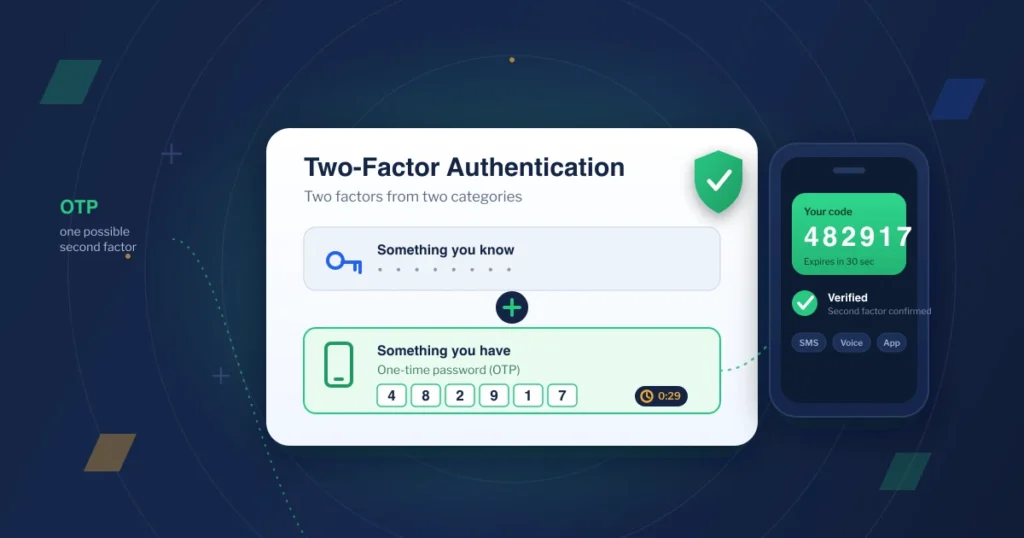
No, an OTP is not the same as two-factor authentication. A one-time password (OTP) is one possible second factor. Two-factor authentication (2FA) is the broader method that requires two factors from different categories — something you know, something you have, or something you are. An OTP on its own is not 2FA. An OTP combined with a password is.
That single distinction settles most of the confusion. The rest of this guide makes the relationship concrete, compares an OTP to the other second factors you could use, and shows how the OTP actually gets delivered as that second factor — the part most explainers skip.
OTP vs 2FA: what’s the actual difference?
Think of them as a category and an item inside it.
Two-factor authentication is a security method. It verifies your identity using two factors from two different categories:
- Something you know — a password or PIN
- Something you have — your phone, an authenticator app, a one-time code
- Something you are — a fingerprint or face scan
A one-time password is a single, short-lived code that works only once and expires within a short window. It belongs to the “something you have” category, because the code is delivered to a device only you control.
So 2FA is the rule (“use two different factor types”), and an OTP is one of the things that can satisfy the second half of that rule.
Is an OTP a form of 2FA?
This is the most-searched version of the question, and the answer has two halves.
An OTP by itself is not 2FA. If a login asks only for a one-time code and nothing else, you are using one factor, not two.
An OTP combined with a password is 2FA. The password is the “something you know,” the OTP is the “something you have,” and together they satisfy the two-category rule. This is exactly how most everyday logins work.
A well-known example is signing into a Google account. You enter your primary password, then a one-time password sent to your phone by text, voice call, or the mobile app. Two factors, two categories — that is 2FA in action, with an OTP doing the second-factor job.
How does an OTP fit into 2FA?
The OTP is the practical way to prove the “something you have” factor without forcing the user to carry a hardware token.
When a user signs in, your system generates a fresh OTP and delivers it to a channel only that user controls — usually their phone via SMS or voice. The user enters the code within its short validity window. Because the code is unique to that login and expires quickly, even a stolen password is not enough to break in on its own.
That is the whole point of 2FA: an attacker would need both the password and live access to the user’s phone at the same moment. The OTP is what makes the second factor possible at scale, for millions of users, without shipping anyone a physical device.
OTP vs other second factors
An OTP is one of several ways to satisfy the second factor. Here is how it compares to the main alternatives, in one view:
| Second factor | How it works | Strength | Trade-off |
|---|---|---|---|
| SMS or voice OTP | A one-time code sent to the user’s phone number | Works on any phone, no app or data needed; instant for the user | Depends on reliable message delivery |
| Authenticator app (TOTP) | A rotating code generated on-device by an app | Works offline; no delivery dependency | Requires the user to install and set up an app |
| Push approval | A tap-to-approve prompt on a trusted device | Fast, low-friction | Needs a smartphone and an installed app |
| Biometrics | Fingerprint or face scan | Nothing to remember or receive | Device-bound; needs supporting hardware |
The right choice depends on your users. For a broad African customer base on every kind of handset, an SMS or voice OTP reaches everyone — no app install, no smartphone required, no data plan. For a deeper channel-by-channel breakdown, see SMS OTP vs authenticator app vs email OTP.
Two related decisions sit just outside this question. Whether to use one-time codes at all versus static passwords is covered in our guide on OTPs vs. static passwords. And to go beyond two factors into full multi-factor design, read the role of OTPs in multi-factor authentication.
Why two-factor authentication matters
A password alone is a single point of failure. Add a second factor and the maths change sharply.
Multi-factor authentication can block over 99.9% of account compromise attacks, according to Microsoft — and 2FA is the everyday, two-factor application of that broader principle. The exact figure covers MFA across Microsoft’s cloud services, but the lesson holds for any login: requiring a second factor stops the overwhelming majority of attacks that rely on a stolen password alone.
The business case is just as direct:
- Fraud prevention. A second factor adds a barrier that a stolen password cannot clear on its own, keeping fraudsters out of accounts that are not theirs.
- Lower support costs. Fewer compromised accounts means fewer password resets, fewer fraud investigations, and less time spent firefighting security incidents.
- Convenience. Adding 2FA is light for the user — a standard sign-in plus one short code. No long, forgettable passwords required.
- Reputation. Customers notice when their data is protected. Strong security earns trust, and trust earns loyalty and word-of-mouth.
- Productivity. When accounts stay secure, your team spends its time improving the product instead of cleaning up breaches.
Delivering the OTP reliably
Here is the part the comparison guides leave out: choosing an OTP as your second factor is the easy decision. Delivering it reliably, in seconds, to every user is the hard one.
A 2FA flow only works if the code arrives. A delayed or undelivered OTP locks out a real customer at the exact moment they are trying to sign in or pay. Across Africa, reliable delivery depends on the quality of the connection to each mobile network — which is the practical problem to solve before you ship 2FA.
This is where Arkesel Phone Number Verification fits. It delivers and verifies one-time passwords as the second factor, sending codes over SMS and voice through direct connections to MTN, Telecel, and AirtelTigo. For high-volume transactional sends, the Arkesel SMS Platform delivers the same OTP traffic at scale, with real-time delivery tracking so you can see exactly which codes landed.
The hard part isn’t choosing a second factor — it’s delivering the OTP reliably. See how Arkesel delivers and verifies OTPs across Africa with Phone Number Verification.
OTP vs 2FA: frequently asked questions
Is an OTP the same as two-factor authentication? No. An OTP is one possible second factor. 2FA is the broader method that requires two factors from different categories. An OTP becomes part of 2FA only when it is paired with another factor, such as a password.
Is an OTP a form of 2FA? An OTP on its own is not 2FA — that is a single factor. An OTP combined with a password is 2FA, because it uses two different factor categories.
Can you have 2FA without an OTP? Yes. An OTP is just one option for the second factor. You can satisfy 2FA with an authenticator app, a push approval, or biometrics instead.
What is the difference between OTP and 2FA? A one-time password is a single, short-lived code. Two-factor authentication is a method that requires two factors from different categories. The OTP can serve as one of those factors; it is not the method itself.
How does an OTP fit into 2FA? The OTP serves as the “something you have” factor. Your system delivers a fresh code to a device the user controls, and they enter it alongside their password to complete a two-factor login.
Secure your logins with reliable OTP delivery
An OTP is one second factor; 2FA is the method that puts it to work alongside a password. Once you have made that call, the only thing standing between your users and a secure login is whether the code actually arrives.
Deliver and verify one-time passwords in seconds with Arkesel Phone Number Verification — or create a free account to start securing your logins today.

Best OTP API Provider 2026: Twilio vs Vonage vs Arkesel Compared
You need an OTP API provider that delivers codes reliably to phone numbers in the African…

SMS OTP vs Authenticator App vs Email OTP (2026 Guide)
SMS OTP vs authenticator app vs email OTP — a balanced comparison plus a decision matrix…

OTP for Fintech Banking: Secure Transactions at Scale
OTP for fintech banking is the layered authentication rail that ties every transaction to a verified…


